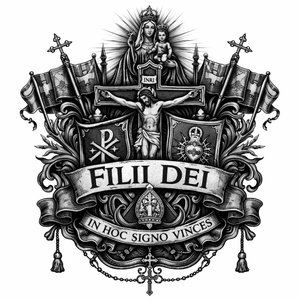
Liturgical Study - Usus Antiquior Feast of Corpus Christi - 1962 Missale Romanum
THEME — The Eucharistic King and the Sacrament of Sacraments
The Feast of Corpus Christi occupies a unique place within the traditional Roman calendar. While Holy Thursday commemorates the institution of the Eucharist amid the sorrowful shadow of the Passion, Corpus Christi allows the Church to celebrate the Eucharistic mystery with unrestrained joy and solemnity. The feast is entirely focused upon Christ truly present in the Blessed Sacrament—Body, Blood, Soul, and Divinity.
The origins of the feast reveal the Church's growing desire to express publicly what she had always believed. Throughout the first millennium, belief in the Real Presence permeated Christian worship, preaching, and devotion. Yet as theological controversies emerged during the Middle Ages, particularly challenges to Eucharistic realism, Providence raised up saints and theologians who would deepen the Church's public witness.
The feast is closely associated with Juliana of Liège, an Augustinian canoness who experienced visions in which she saw the liturgical year represented as a full moon with one darkened section. She came to understand that the missing portion symbolized the absence of a feast specifically honoring the Blessed Sacrament. Through her efforts and those of other clergy and religious, devotion spread until it received papal approval.
The feast was ultimately extended to the universal Church by Pope Urban IV through the Bull Transiturus de hoc Mundo in 1264. The Pope commissioned Thomas Aquinas to compose the liturgical texts for the feast. The result was one of the greatest treasures of Catholic liturgical literature.
From Aquinas came:
Pange Lingua
Tantum Ergo
O Salutaris Hostia
Lauda Sion
Sacris Solemniis
For nearly eight centuries these hymns have formed the theological and devotional heart of Corpus Christi celebrations throughout the Catholic world.
The traditional liturgy emphasizes four inseparable realities:
The Eucharist as Sacrifice
The Eucharist as Real Presence
The Eucharist as Communion
The Eucharist as Judgment
All four appear prominently in the Epistle and Gospel of the Mass.
READINGS
Epistle: 1 Corinthians 11:23–29
Gospel: John 6:56–59
EPISTLE — 1 CORINTHIANS 11:23–29
The Eucharistic Sacrifice and the Danger of Unworthy Communion
The Epistle for Corpus Christi contains the earliest written account of the institution of the Eucharist.
St. Paul writes:
"For I have received of the Lord that which also I delivered unto you."
These words establish a principle that would become central to Catholic theology: Apostolic Tradition.
Paul is not inventing a new rite. He is transmitting what he himself received. The Eucharist is therefore not merely a community meal developed by early Christians. It is a sacred reality entrusted by Christ Himself to His Apostles and handed down faithfully through the Church.
The language of reception and transmission became one of the principal biblical foundations for Catholic understanding of Sacred Tradition. What Paul received, he delivered. What the Apostles delivered, the Church preserves.
The institution narrative follows:
"This is my body."
The Church has always understood these words literally.
Christ does not say:
"This represents my body."
Nor:
"This symbolizes my body."
He says:
"This is my body."
The Fathers consistently interpreted these words realistically.
John Chrysostom taught that the same Christ who spoke these words at the Last Supper continues to act through the priest at every Mass.¹
Likewise, Ambrose of Milan argued that if God's word could create the universe from nothing, it could certainly transform bread and wine into Christ's Body and Blood.²
The Epistle then moves from institution to sacrifice:
"For as often as you shall eat this bread and drink the chalice, you shall show the death of the Lord until he come."
The Eucharist does not repeat Calvary.
Neither is it merely a memorial in the modern sense of remembering something absent.
Rather, the sacrifice of Calvary becomes sacramentally present.
This is why the Church speaks of the Mass as an unbloody re-presentation of the one sacrifice of Christ.
Aquinas explains that the Eucharist is simultaneously sacrament and sacrifice because it contains Christ Himself under sacramental signs.³
Yet the most striking portion of the Epistle is Paul's warning:
"Whosoever shall eat this bread or drink the chalice of the Lord unworthily shall be guilty of the body and blood of the Lord."
This warning only makes sense if Christ is truly present.
One cannot profane a symbol in the manner Paul describes.
One can only become guilty of Christ's Body and Blood if Christ's Body and Blood are truly present.
Paul's language becomes even more severe:
"He that eateth and drinketh unworthily eateth and drinketh judgment to himself."
The traditional Church consistently interpreted this passage as requiring proper disposition before reception of Holy Communion.
The Fathers repeatedly warned against sacrilegious Communion.
The Council of Trent reaffirmed that those conscious of mortal sin must first seek sacramental confession before approaching the altar.⁴
This teaching remains reflected in current canon law and Catholic discipline.
Thus the Epistle presents both the immense privilege and immense responsibility of Eucharistic reception.
The Eucharist gives life.
The Eucharist also demands reverence.
GOSPEL — JOHN 6:56–59
The Bread of Life and the Reality of Eucharistic Communion
The Gospel continues the Bread of Life discourse begun earlier in John 6.
Christ declares:
"He that eateth my flesh and drinketh my blood abideth in me, and I in him."
The emphasis here shifts from sacrifice to communion.
The Eucharist is not merely Christ given to believers.
The Eucharist establishes mutual indwelling.
The believer remains in Christ.
Christ remains in the believer.
This language recalls Christ's later teaching regarding the vine and branches in John 15. Spiritual life depends upon union with Him.
The Eucharist serves as the sacramental means by which this union is strengthened and deepened.
The realism of Christ's language remains impossible to ignore.
Throughout John 6, the crowd repeatedly misunderstands Him in a literal sense.
Yet Christ never retreats from the literal meaning.
Instead, He intensifies it.
The reaction of the crowd demonstrates that they understood Him correctly.
The reaction of many disciples confirms it.
"This saying is hard."
Had Christ intended only symbolism, clarification would have been easy.
Instead, many disciples depart.
The Fathers universally interpreted the discourse Eucharistically.
Ignatius of Antioch described heretics as those who abstain from the Eucharist because they refuse to confess that it is the flesh of Christ.⁵
Cyril of Jerusalem instructed Christians not to judge the Eucharist according to appearances but according to Christ's words.⁶
The discourse culminates with Christ comparing Himself to the manna of the wilderness.
"Not as your fathers did eat manna, and are dead."
The contrast is profound.
Manna sustained biological life temporarily.
The Eucharist communicates supernatural life eternally.
Manna fed Israel for a day.
The Eucharist prepares souls for eternity.
Aquinas therefore calls the Eucharist both viaticum and pledge of future glory.⁷
The sacrament strengthens the pilgrim Church on earth while simultaneously pointing toward the heavenly banquet.
THE ORIGINS OF CORPUS CHRISTI AND EUCHARISTIC PROCESSIONS
One of the most distinctive features of Corpus Christi is the public procession.
Unlike many feasts that remain largely within church walls, Corpus Christi traditionally moves into streets, villages, and cities.
The symbolism is profound.
The same Christ hidden beneath sacramental veils enters the public square as King.
Historically, processions served several purposes:
public profession of faith
acts of reparation
blessing of communities
witness to Christ's kingship
The faithful accompanied the Blessed Sacrament with hymns, incense, banners, flowers, and prayer.
The procession became a visible proclamation that Christ is not merely Lord of individual souls but Lord of all creation.
The Eucharistic processions associated with Corpus Christi remain among the most beautiful public manifestations of Catholic faith.
THEOLOGICAL SYNTHESIS — SACRIFICE, PRESENCE, COMMUNION, AND JUDGMENT
The Epistle and Gospel reveal the four great dimensions of Eucharistic theology.
Sacrifice
The Eucharist makes present the sacrifice of Calvary.
Presence
Christ is truly, really, and substantially present.
Communion
The faithful participate in Christ's life through sacramental union.
Judgment
Reception demands worthy disposition and reverence.
To separate any one of these dimensions from the others produces distortion.
The fullness of Catholic Eucharistic theology requires all four.
PRACTICAL APPLICATION
Corpus Christi challenges Catholics to examine their Eucharistic faith.
Do we approach the altar with reverence?
Do we prepare through confession when necessary?
Do we spend time in Eucharistic adoration?
Do we recognize Christ's presence in the tabernacle?
The Church's traditional practices remain profoundly relevant:
Eucharistic fasting
frequent confession
Holy Hours
Benediction
Corpus Christi processions
visits to the Blessed Sacrament
These practices flow naturally from belief in the Real Presence.
Heaven Hidden Beneath Veils
Corpus Christi proclaims one of the most astonishing truths of Christianity.
The God whom the heavens cannot contain chooses to dwell sacramentally among His people.
The eternal Son who took flesh in Bethlehem remains present upon Catholic altars throughout the world.
The Eucharist is therefore not merely a reminder of Christ.
It is Christ.
The Eucharist is the sacrifice of Calvary made present.
The Bread of Angels given to pilgrims.
The bond of ecclesial unity.
The pledge of future glory.
Thus Corpus Christi stands as a joyful proclamation that the King of Kings remains with His people until the end of the age.
ENDNOTES
John Chrysostom, Homilies on First Corinthians.
Ambrose of Milan, On the Mysteries.
St. Thomas Aquinas, Summa Theologiae, III, qq.73–83.
Council of Trent, Session XIII; Session XXII.
Ignatius of Antioch, Letter to the Smyrnaeans.
Cyril of Jerusalem, Mystagogical Catecheses.
St. Thomas Aquinas, Summa Theologiae, III, q.79.
Pope Pius XII, Mediator Dei.
Pope Paul VI, Mysterium Fidei.
Thomas Aquinas, Lauda Sion, Pange Lingua, Tantum Ergo.