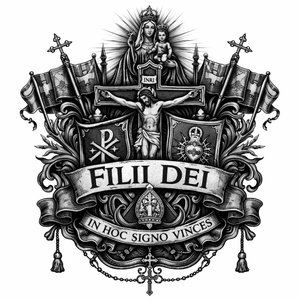
THEME — The New Manna and the Food of Eternal Life
The Solemnity of the Most Holy Body and Blood of Christ follows immediately upon Trinity Sunday, and the placement is deeply significant. Having contemplated the inner life of God in the mystery of the Trinity, the Church now turns to the greatest gift that the Triune God has bestowed upon His people: the Holy Eucharist.
Corpus Christi is not merely a feast about Holy Communion. It is a feast celebrating the entire Eucharistic mystery. The Eucharist is simultaneously sacrifice, sacrament, communion, and presence. It is the sacramental continuation of Calvary, the abiding presence of Christ among His people, the bond of unity within the Church, and the pledge of eternal glory.
The readings for this feast reveal a remarkable progression through salvation history. Moses recalls the manna that sustained Israel in the wilderness. St. Paul teaches that the Eucharistic chalice and bread are a true participation in Christ Himself. Finally, Christ declares in the Bread of Life discourse that His flesh is true food and His blood true drink.
The Church therefore presents the Eucharist as the fulfillment of everything that preceded it. The manna of the desert, the Passover sacrifice, the Temple offerings, and the covenant meals of Israel all point toward the Eucharistic banquet instituted by Christ on the night before He died.
As Aquinas writes, all the sacraments contain grace, but the Eucharist contains Christ Himself. The Eucharist is therefore rightly called the Sacrament of Sacraments.¹
READINGS
First Reading: Deuteronomy 8:2–3, 14b–16a
Responsorial Psalm: Psalm 147
Second Reading: 1 Corinthians 10:16–17
Gospel: John 6:51–58
FIRST READING — DEUTERONOMY 8:2–3, 14b–16a
Manna in the Wilderness and the Education of God's People
Moses addresses Israel near the conclusion of their forty-year journey through the desert. The generation standing before him is preparing to enter the Promised Land, and Moses reminds them that the hardships of the wilderness were not meaningless suffering but divine instruction.
"He therefore let you be afflicted with hunger, and then fed you with manna."
The manna occupies a central place in Israel's memory because it demonstrated total dependence upon God. Every morning, except on the Sabbath, the people received bread from heaven. They could not store it indefinitely. They could not manufacture it themselves. They survived only because God continually provided.
The Fathers saw in the manna one of the clearest Old Testament types of the Eucharist. Like the Eucharist, manna came from heaven. Like the Eucharist, it sustained God's pilgrim people. Like the Eucharist, it was given daily. Yet the similarities only highlight the superiority of the New Covenant gift.
The manna preserved earthly life temporarily. The Eucharist communicates supernatural life eternally.
Christ Himself explicitly makes this comparison in John 6:
"Your fathers ate manna in the desert and are dead."
The manna was miraculous, but it could not conquer death. The Eucharist does.
Aquinas notes that God frequently prepared mankind for greater realities through lesser signs.² The manna therefore served as a pedagogical instrument, teaching Israel dependence upon God while simultaneously foreshadowing the true Bread from Heaven that would come in Christ.
The reading also contains Moses' famous statement:
"Not by bread alone does one live, but by every word that comes forth from the mouth of God."
The Eucharist unites both dimensions. Christ is not only the Bread of Life but also the eternal Word made flesh. In the Eucharist, the Word who created the universe becomes food for the soul.
RESPONSORIAL PSALM — PSALM 147
God Feeds His People
Psalm 147 celebrates God's providential care for His people.
"He has proclaimed his word to Jacob, his statutes and ordinances to Israel."
The psalm unites two themes that frequently appear together throughout Scripture: divine revelation and divine nourishment.
God speaks.
God feeds.
The Old Covenant received both the Law and the manna. The New Covenant receives both the Gospel and the Eucharist.
The Fathers frequently emphasized that Christ nourishes the faithful through both Word and Sacrament. The liturgy itself reflects this reality. The faithful are first fed from the table of Scripture and then from the altar of sacrifice.
The psalm's language of abundance and blessing naturally directs the Church toward Eucharistic fulfillment. God's providence is no longer merely agricultural or political. In Christ, divine providence becomes sacramental.
The Eucharist reveals a God who does not merely provide gifts but gives Himself.
SECOND READING — 1 CORINTHIANS 10:16–17
Participation in the Body and Blood of Christ
St. Paul writes:
"The cup of blessing that we bless, is it not a participation in the blood of Christ?"
This passage is among the most important Eucharistic texts in the New Testament because it demonstrates that the earliest Christians understood the Eucharist as far more than symbolic remembrance.
The Greek word translated "participation" (koinonia) signifies real communion and sharing. Paul does not ask whether the Eucharist reminds believers of Christ. He asks whether it brings them into participation with Christ.
The expected answer is yes.
The Eucharist creates communion because Christ Himself is present.
The phrase "cup of blessing" also evokes the Passover meal. Jewish families concluded the Passover celebration with a blessing over a cup of wine. Christ transformed this covenant meal at the Last Supper by identifying the cup with His own Blood.
The Eucharist therefore fulfills Passover just as it fulfills manna.
Paul then moves from sacramental theology to ecclesiology:
"Because the loaf of bread is one, we, though many, are one body."
The Eucharist does not merely unite the individual believer to Christ. It unites believers to one another within the Mystical Body.
Augustine beautifully summarized this reality by describing the Eucharist as both sign and cause of ecclesial unity.³
This unity, however, is not sociological. The Church is not united by ethnicity, culture, or politics. The Church is united because all partake of the same Christ.
GOSPEL — JOHN 6:51–58
The Bread of Life and the Reality of Christ's Presence
The Bread of Life discourse stands at the center of Catholic Eucharistic theology.
Christ declares:
"I am the living bread that came down from heaven."
The comparison to manna immediately becomes explicit. Yet Christ quickly moves beyond comparison to contrast.
The manna sustained physical life.
Christ gives eternal life.
The manna was bread.
Christ gives His flesh.
The turning point comes when Christ says:
"The bread that I will give is my flesh for the life of the world."
The crowd reacts with shock:
"How can this man give us his flesh to eat?"
At this moment, Jesus has every opportunity to clarify if He has been misunderstood.
Instead, He intensifies His language.
"Unless you eat the flesh of the Son of Man and drink his blood, you do not have life within you."
The realism becomes even stronger in the original Greek. Earlier Christ uses the ordinary verb for eating. Later He shifts to a more graphic term often translated as "gnaw" or "chew." The language becomes more literal, not less.
The reaction of the disciples is equally significant.
Many leave.
Many abandon Him.
Yet Christ does not call them back to explain that He was speaking symbolically.
The Fathers consistently viewed this discourse as Eucharistic.
Ignatius of Antioch condemned those who denied the Eucharist because they denied that Christ truly came in the flesh.⁴
Cyril of Jerusalem instructed catechumens to believe Christ's words rather than the testimony of the senses.⁵
Aquinas later explained that the substance of bread and wine becomes the Body and Blood of Christ while the appearances remain.⁶
The discourse therefore provides the biblical foundation for the doctrine later defined by the Council of Trent as Transubstantiation.
Most importantly, Christ connects the Eucharist directly to eternal life:
"Whoever eats my flesh and drinks my blood has eternal life."
The Eucharist is not an optional devotion. It is the ordinary means through which Christ nourishes supernatural life within the soul.
THEOLOGICAL SYNTHESIS — THE FOURFOLD MYSTERY OF THE EUCHARIST
The readings reveal four dimensions of Eucharistic theology.
First, the Eucharist is Sacrifice. The sacrifice of Calvary becomes sacramentally present upon the altar.
Second, the Eucharist is Presence. Christ is truly, really, and substantially present.
Third, the Eucharist is Communion. The faithful participate in the life of Christ and the unity of the Church.
Fourth, the Eucharist is a Pledge of Future Glory. The Eucharist anticipates the heavenly banquet and prepares the soul for eternal life.
These four dimensions are inseparable. To reduce the Eucharist to mere symbolism is to lose the richness of the mystery.
PRACTICAL APPLICATION
Corpus Christi challenges Catholics to examine their Eucharistic faith.
Do we approach the altar with reverence?
Do we prepare through prayer and confession?
Do we recognize that the Eucharist is Christ Himself?
The Church has always encouraged:
frequent confession
worthy reception
Eucharistic adoration
visits to the Blessed Sacrament
participation in Corpus Christi processions
The Eucharist is not merely something we receive. It is Someone we encounter.
THE BREAD OF ANGELS
The manna fed Israel for forty years.
The Eucharist feeds the Church until the end of time.
The Eucharist is heaven's food given to pilgrims on earth. It is the fulfillment of every sacrifice, every covenant meal, and every promise of divine nourishment.
In the Blessed Sacrament, Christ remains with His people, fulfilling His promise:
"Behold, I am with you always."
Corpus Christi therefore stands as a joyful proclamation that God has not merely spoken to humanity or acted for humanity.
He has given Himself.
ENDNOTES
St. Thomas Aquinas, Summa Theologiae, III, q.65.
ST III, q.60.
Augustine of Hippo, Sermons.
Ignatius of Antioch, Letter to the Smyrnaeans.
Cyril of Jerusalem, Mystagogical Catecheses.
ST III, q.75.
Council of Trent, Session XIII.