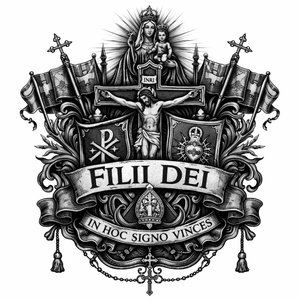
Liturgical Study - Usus Antiquior - 1962 Missal - Trinity Sunday
THEME — The Crown of the Liturgical Year and the Mystery Behind All Mysteries
Trinity Sunday occupies a unique place in the traditional Roman calendar. Unlike Christmas, Easter, Ascension, or Pentecost, the feast commemorates no specific event in salvation history. Rather, it celebrates the deepest reality revealed by every event in salvation history: the inner life of God Himself.
The placement of the feast immediately after Pentecost is profoundly intentional. The Church has spent six months leading the faithful through the great mysteries of redemption. Advent prepared for the coming of Christ. Christmas celebrated His Incarnation. Lent prepared souls for His sacrifice. Easter proclaimed His victory over death. The Ascension revealed His glorification. Pentecost manifested the Holy Ghost and the public mission of the Church.
Having completed this journey, the Church now asks a question that lies beneath all the others:
Who is this God who has accomplished these mighty works?
The answer is the mystery of the Most Holy Trinity.
The Father creates.
The Son redeems.
The Holy Ghost sanctifies.
Yet there are not three gods but one God.
Trinity Sunday therefore serves as the theological crown of the entire liturgical year. It reminds the faithful that every divine work ultimately proceeds from and returns to the Triune God.
Historically, the feast emerged gradually in the Western Church. Although the doctrine of the Trinity had always stood at the center of Christian belief, the establishment of a specific feast dedicated to the mystery developed over centuries. Monastic communities, especially in the Carolingian period, cultivated particular devotion to the Trinity. By the Middle Ages, the feast had spread throughout much of Europe and was eventually extended to the universal Church by Pope John XXII.
The feast also possesses a strongly anti-heretical character. Nearly every major doctrinal controversy of the early Church revolved around the Trinity.
The Arians denied the divinity of Christ.
The Macedonians denied the divinity of the Holy Ghost.
The Sabellians confused the Persons.
The Tritheists divided God into three separate beings.
Against all these errors, the Church proclaimed that God is one divine essence existing eternally as Father, Son, and Holy Ghost.
Thus Trinity Sunday is not merely a feast of devotion. It is also a feast of doctrinal triumph—a yearly reminder that salvation depends upon knowing and worshipping the true God.
READINGS
Epistle: Romans 11:33–36
Gospel: Matthew 28:18–20
EPISTLE — ROMANS 11:33–36
The Depth of Divine Wisdom and the Limits of Human Reason
The Epistle appointed for Trinity Sunday does something remarkable. Rather than attempting to explain the Trinity, St. Paul responds to God with awe.
"O the depth of the riches of the wisdom and of the knowledge of God!"
This reaction is deeply significant.
Modern minds often approach mystery as a problem to be solved. The Fathers and Doctors approached mystery as a reality to be contemplated.
The Church does not celebrate Trinity Sunday because she has fully explained God. She celebrates Trinity Sunday because God has revealed enough of Himself to draw mankind into worship.
Paul's words come at the conclusion of an extended discussion concerning God's providential plan for Jews and Gentiles. Having contemplated the divine wisdom governing salvation history, he arrives at a point where explanation yields to adoration.
"How incomprehensible are his judgments, and how unsearchable his ways."
This does not imply irrationality.
Aquinas carefully distinguishes mystery from contradiction. A mystery exceeds human reason; it does not violate reason (ST I, q.32).¹ The Trinity is above reason but never against reason.
The Church therefore rejects two opposite errors.
One error is rationalism, which insists that only what can be fully comprehended should be believed.
The other is fideism, which treats faith as irrational.
Catholic theology rejects both extremes.
Faith perfects reason.
Reason prepares the way for faith.
Reason demonstrates that belief is reasonable.
Faith receives truths that exceed reason's natural powers.
Paul's language also teaches humility.
"Who hath known the mind of the Lord?"
The Fathers frequently interpreted this verse as a warning against intellectual pride.
The greatest saints and theologians consistently display profound humility when speaking of God. Aquinas himself, after receiving a mystical experience near the end of his life, famously declared that all he had written seemed like straw compared to the reality of God.²
Trinity Sunday therefore reminds the faithful that theology ultimately culminates in contemplation.
The goal is not mastery of God.
The goal is union with God.
Paul concludes:
"For of him, and by him, and in him, are all things."
This verse summarizes the entire Christian understanding of reality.
Everything originates from God.
Everything is sustained by God.
Everything ultimately returns to God.
The Fathers frequently interpreted this verse in a Trinitarian manner:
from the Father
through the Son
in the Holy Ghost
Thus even before the Gospel is proclaimed, the liturgy directs attention toward the Triune source of all existence.
GOSPEL — MATTHEW 28:18–20
Baptism Into the Life of the Trinity
The Gospel for Trinity Sunday concludes St. Matthew's account of the Great Commission.
Having conquered death and risen in glory, Christ commands His Apostles:
"Going therefore, teach ye all nations; baptizing them in the name of the Father, and of the Son, and of the Holy Ghost."
This passage became one of the most important scriptural foundations for Trinitarian doctrine.
The wording itself is extraordinary.
Christ does not say:
"In the names"
but rather:
"In the name."
The singular reveals unity.
The three Persons reveal distinction.
One divine essence.
Three distinct Persons.
The Church Fathers repeatedly cited this passage against the Arians.
If the Son were merely a creature, His name could never be placed alongside the Father's within the sacramental formula that initiates souls into divine life.
Likewise, if the Holy Ghost were merely an impersonal force, His inclusion would be incomprehensible.
Athanasius argued that baptism brings man into communion with God Himself. Therefore the Son and the Holy Ghost must possess the same divine nature as the Father.³
This Gospel also reveals something essential about salvation.
Christ does not merely command the Apostles to preach ethical principles or philosophical truths.
He commands them to baptize.
The goal of Christianity is not merely instruction but incorporation.
Baptism introduces man into participation in Trinitarian life.
Aquinas teaches that sanctifying grace is a created participation in the divine nature (ST I-II, q.110).⁴ Through baptism, the soul becomes:
a child of the Father
a member of Christ
a temple of the Holy Ghost
The Christian life is therefore fundamentally Trinitarian from its very beginning.
Every sacrament flows from baptism.
Every sacrament deepens Trinitarian communion.
The Fathers frequently taught that baptism is not merely cleansing from sin but supernatural adoption.
Through grace, the believer enters into the Son's own relationship with the Father.
This is why the Church insists that salvation is infinitely more than moral improvement.
The goal is participation in divine life itself.
The Gospel concludes:
"Behold I am with you all days, even unto the consummation of the world."
The promise is profoundly Trinitarian.
The Son remains present through His Church.
The Holy Ghost animates the Church.
The Father sustains the Church.
The entire mission of evangelization flows from and returns to the Trinity.
THE ORIGINS OF TRINITY SUNDAY
Unlike Pentecost or Easter, Trinity Sunday developed from theological reflection rather than historical commemoration.
For centuries the Church celebrated the Trinity implicitly within every liturgy.
Every Mass was Trinitarian.
Every baptism was Trinitarian.
Every blessing was Trinitarian.
Yet as heresies multiplied, devotion to the Trinity became increasingly explicit.
The Arian crisis alone shook the Christian world for centuries.
At one point, much of the episcopate had fallen into confusion concerning Christ's divinity.
The heroic defense mounted by figures such as:
Athanasius of Alexandria
Hilary of Poitiers
Basil the Great
Gregory Nazianzen
ultimately preserved orthodox belief.
The feast emerged partly as a celebration of these doctrinal victories.
By the High Middle Ages, Trinity Sunday had become one of the most beloved feasts of the Roman Rite.
Medieval theologians frequently regarded it as the interpretive key to the entire liturgical year.
Everything celebrated from Advent through Pentecost ultimately reveals the Triune God.
THEOLOGICAL SYNTHESIS — THE TRINITY AS THE PURPOSE OF CREATION AND REDEMPTION
The Epistle and Gospel together reveal two complementary truths.
Romans emphasizes the incomprehensibility of God.
Matthew reveals God's self-disclosure.
Together they teach that while God remains infinitely beyond human comprehension, He has nevertheless made Himself known.
The Trinity explains:
creation
redemption
sanctification
Heaven itself
Why does God create?
Not from need.
Why does God redeem?
Not from deficiency.
Why does God sanctify?
Not from necessity.
Rather, creation and redemption flow from the superabundance of divine goodness.
The Triune God, perfect in Himself from all eternity, freely wills to communicate His goodness to creatures.
The ultimate goal of salvation is therefore participation in Trinitarian life.
The Eastern Fathers frequently referred to this as divinization (theosis).⁵
Not that man becomes God by nature.
Rather, man participates in God by grace.
Thus the Trinity is not merely the beginning of salvation.
The Trinity is also its end.
The Father, Son, and Holy Ghost constitute the eternal destiny of every saint.
MAGISTERIAL INSIGHT
The doctrines celebrated on Trinity Sunday were solemnly articulated at:
First Council of Nicaea
First Council of Constantinople
Fourth Lateran Council
Council of Florence
These councils clarified the Church's teaching concerning:
one divine essence
three divine Persons
eternal generation
eternal procession
The traditional Athanasian Creed (Quicumque Vult) became one of the Church's greatest summaries of Trinitarian doctrine and was historically recited frequently within the Divine Office.⁶
PRACTICAL APPLICATION — Living Trinitarian Lives
Every Christian already lives a profoundly Trinitarian life.
The Sign of the Cross invokes the Trinity.
The sacraments communicate Trinitarian life.
The Mass is directed toward the Father, through the Son, in the Holy Ghost.
The family itself reflects, however imperfectly, the communion and self-giving love existing eternally within God.
Trinity Sunday therefore challenges the faithful to move beyond merely knowing about the Trinity and to live from the Trinity.
Prayer, charity, worship, and holiness all become participation in divine life.
CONCLUSION
After celebrating the mysteries of Christ's birth, death, resurrection, ascension, and the coming of the Holy Ghost, the Church finally directs her gaze toward the mystery from which all those works proceed.
The Father eternally begets the Son.
The Son eternally receives His divine nature from the Father.
The Holy Ghost eternally proceeds as the bond of divine love.
This communion existed before creation, before angels, before time itself.
And through grace, mankind is invited into it.
Thus Trinity Sunday stands as the theological crown of the liturgical year, reminding the faithful that the ultimate purpose of salvation is not merely forgiveness of sins but participation in the life of the Father, and of the Son, and of the Holy Ghost.
ENDNOTES
St. Thomas Aquinas, Summa Theologiae, I, q.32.
Thomas Aquinas, final testimony recorded by early biographers.
Athanasius of Alexandria, Orations Against the Arians.
ST I-II, q.110.
Athanasius of Alexandria, On the Incarnation; Basil the Great, On the Holy Spirit.
Athanasian Creed.
Augustine of Hippo, De Trinitate.
Hilary of Poitiers, De Trinitate.
Gregory Nazianzen, Theological Orations.
Council of Florence, Laetentur Caeli.