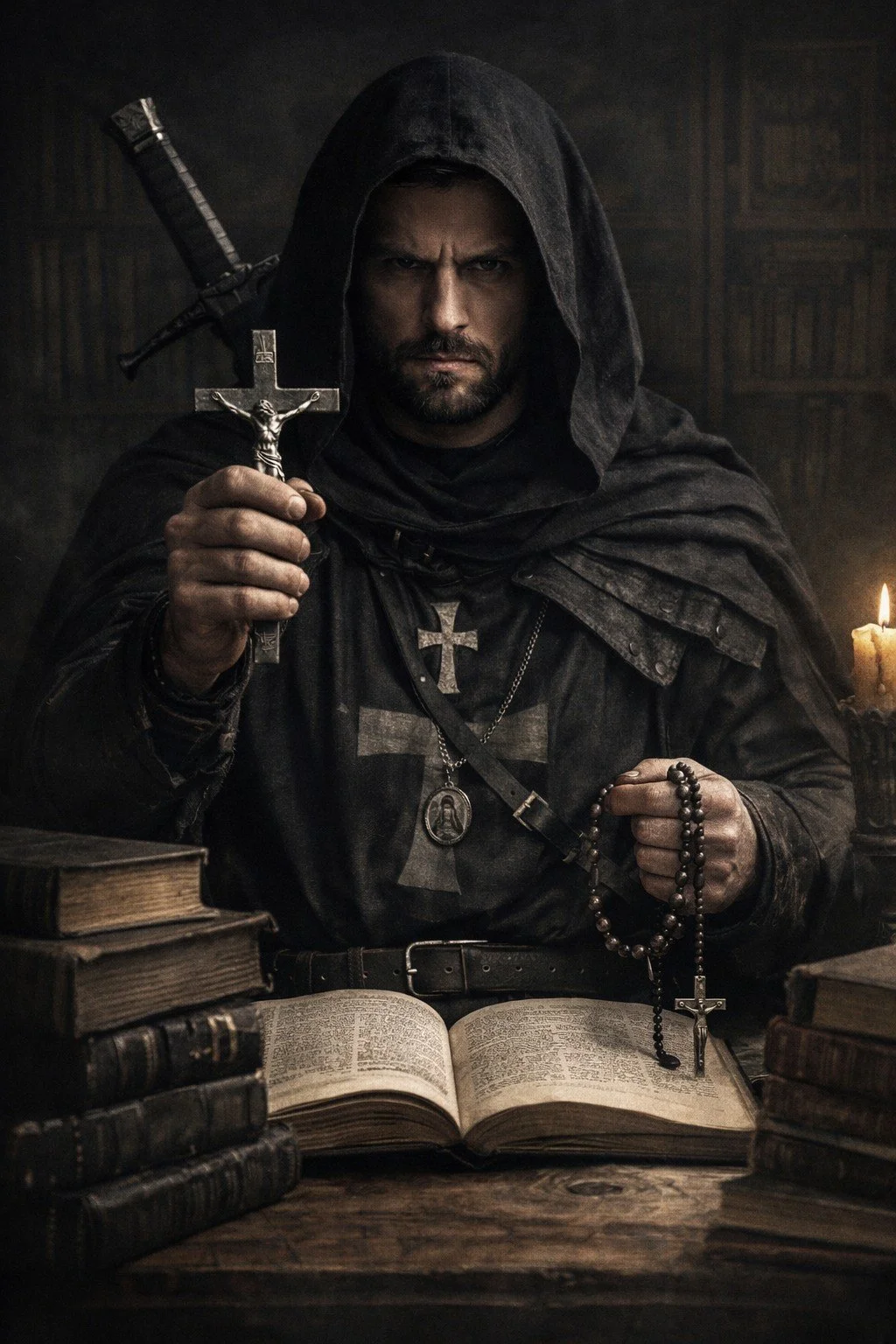
A Full AI Traditionalist Recreation of Magnifica Humanitas
What follows is a recreation/rewrite of the Papal Encyclical Magnifica Humanitas that absolutely EXCLUDES all teachings since the Second Vatican Council. See if you can spot the tonal and teaching difference.
_______________________________________________________________________
ENCYCLICAL LETTER
MAGNIFICA HUMANITAS
OF HIS HOLINESS
POPE LEO XIV
TO THE PATRIARCHS, PRIMATES, ARCHBISHOPS, BISHOPS,
AND TO ALL THE CLERGY AND FAITHFUL OF THE CATHOLIC WORLD
ON SAFEGUARDING THE HUMAN PERSON
IN THE TIME OF ARTIFICIAL INTELLIGENCE
Health and Apostolic Benediction.
Rewritten in Accordance Solely with the Perennial Teaching
of the Holy Catholic Church Prior to the Second Vatican Council
Introduction
The Crisis of Our Age
1. The magnificence of man does not consist in his machines, nor in the multiplication of comforts, nor in the conquest of nature through technical power, but in this alone: that man, created in the image and likeness of Almighty God, is called to eternal union with Him through sanctifying grace and the redemption wrought by Jesus Christ Our Lord. Our Savior Himself declared: "Seek ye therefore first the kingdom of God and His justice, and all these things shall be added unto you" (Matt. 6:33). In this divine command lies the measure of all human progress.
2. In every age there arise new temptations by which man, intoxicated with his own works, seeks to establish an earthly kingdom apart from God. Thus was built the Tower of Babel; thus arose the pagan empires; thus were propagated the errors of rationalism, liberalism, socialism, and atheistic materialism, each in its turn condemned by Our predecessors. And now in this age there appears a new temptation: that man, through artificial intelligence and the vast extension of technological power, shall transcend the limitations placed upon him by his Creator and construct a civilization sufficient unto itself — a civilization without God. Yet Holy Scripture warns with terrible simplicity: "Unless the Lord build the house, they labor in vain that build it" (Ps. 126:1).
3. The present crisis is therefore not principally technological but spiritual. The gravest danger confronting mankind is not that machines may become powerful, but that men may become godless. Our predecessor of blessed memory, Leo XIII, saw a similar danger in the industrial disorders of his age and responded with the great encyclical Rerum Novarum (1891), the 135th anniversary of which we observe this year with deep veneration. Faithful to the method of that illustrious predecessor — which is the method of the Church herself — We intend to illuminate the present moment not by the shifting counsels of human opinion, but by the unchanging light of Sacred Scripture, Sacred Tradition, and the natural law inscribed by God upon the rational soul. For the principles by which the Church guides her children do not change with the revolutions of technology; they are drawn from the eternal wisdom of God.
4. Saint Thomas Aquinas, the Angelic Doctor and Common Doctor of the Church, teaches that the natural law is nothing other than the rational creature's participation in the eternal law of God (Summa Theologiae, I-II, q. 91, a. 2). Upon this immovable foundation — Holy Scripture, the Tradition of the Fathers and Doctors, the Definitions of the Councils, and the natural law illumined by faith — We set forth the principles by which Catholics and all men of good will may judge the new things of this digital age.
Chapter One
The Primacy of the Salvation of Souls
I. The Supreme Law of the Church
5. The Church founded by Jesus Christ exists first and principally for one purpose: the salvation of immortal souls. This sacred mission surpasses every merely temporal concern, for the soul is eternal whereas earthly civilization passes away like smoke. Our Divine Savior declared: "What doth it profit a man, if he gain the whole world, and suffer the loss of his own soul?" (Matt. 16:26). This question — uttered by the mouth of Eternal Truth — remains the decisive criterion by which every civilization, every political system, every economy, and every technological development must be judged. The Church therefore cannot measure human progress solely by increased productivity, material comfort, or the alleviation of bodily suffering. Such measures belong to earthly prudence alone and are gravely insufficient when detached from man's supernatural end.
6. Leo XIII taught that civil society exists for the common good (Immortale Dei, 1885). But the highest common good of man is not bodily prosperity — it is eternal beatitude in God. Accordingly, any social order that weakens faith, promotes vice, corrupts morals, undermines family life, obscures divine truth, or habituates souls to forgetfulness of God must be judged a failure, even if it produces unprecedented material abundance. The same standard governs our evaluation of artificial intelligence and every other powerful technology: not what it produces materially, but what it does to immortal souls.
II. Sin, Not Poverty, Is the True Catastrophe
7. The modern world increasingly speaks as though the alleviation of temporal suffering were itself the highest purpose of society. This error, though clothed in humanitarian language, is profoundly contrary to Catholic doctrine. The Son of God did not become Incarnate principally to establish economic equality, universal comfort, or perpetual earthly peace. He came "to save His people from their sins" (Matt. 1:21). Sin — not poverty — is the primary catastrophe of mankind. Poverty may sanctify the soul through humility and dependence upon God; but mortal sin separates the soul from God eternally.
8. The modern spirit fears physical suffering far more than spiritual death. Yet Our Lord warned: "Fear ye not them that kill the body and are not able to kill the soul: but rather fear Him that can destroy both soul and body in hell" (Matt. 10:28). A civilization that seeks to eliminate bodily discomfort while normalizing impurity, blasphemy, sacrilege, contraception, divorce, and indifference toward divine truth does not elevate mankind but destroys him spiritually. No technological achievement can compensate for the loss of sanctifying grace. The soul in mortal sin is more truly impoverished than the beggar starving in the street; for bodily suffering ends with death, but eternal separation from God endures forever.
9. Therefore the Church must never permit herself to become merely a humanitarian institution concerned chiefly with temporal well-being while neglecting the conversion of sinners, the preaching of repentance, the administration of the Sacraments, and the salvation of souls. Pius XI warned that "the Church can never abandon the duty imposed upon her by God to oppose false doctrines and immoral practices" (Quadragesimo Anno, 1931). This obligation is not diminished but heightened when the instruments of false doctrine become as powerful as artificial intelligence.
III. Redemptive Suffering and the Cross
10. The modern spirit seeks to eradicate suffering entirely, treating all pain as meaningless evil to be abolished by technology. Yet Catholic doctrine teaches that suffering united to Christ crucified becomes redemptive. Saint Paul writes: "I fill up those things that are wanting of the sufferings of Christ, in my flesh, for His body, which is the Church" (Col. 1:24). The Cross stands at the center of Christian civilization, not as a scandal to be softened, but as the supreme wisdom of God. Any social order that teaches men to flee sacrifice, avoid penance, reject discipline, and seek constant amusement weakens souls and prepares them poorly for eternity. Technology must therefore never be permitted to create a civilization of perpetual distraction in which prayer, contemplation, silence, and devotion are crowded out by endless stimulation. The saints were not formed by comfort but by grace operating through trial.
Chapter Two
The Human Person: His Nature, Dignity, and Supernatural End
I. Man Created in the Image of God
11. The first and most fundamental truth of Christian anthropology is that man is created in the image and likeness of God (Gen. 1:26-27). This doctrine, set forth in the opening pages of Holy Scripture and expounded by the Fathers of the Church with singular care, is the source and foundation of all Catholic social teaching. Saint Augustine writes: "Our heart is restless until it repose in Thee" (Confessions, I, 1). The ultimate end of man lies not in any earthly thing, however excellent, but in God alone. From this divine origin flows the inherent dignity of every human being — a dignity that no earthly power may rightly despise or destroy, because every man, however poor or afflicted, bears within his soul the imprint of his Maker.
12. Saint Thomas Aquinas, following Aristotle and illumined by the light of faith, teaches that man is a rational animal — a being composed of body and soul, in whom intellect and will are the highest natural faculties. The intellect, open to all being, tends by nature toward truth; the will, guided by the intellect, tends toward the good. These faculties, wounded but not destroyed by original sin, are ordered by nature to God as their supreme Truth and supreme Good. From this hierarchy of faculties we derive the fundamental rule by which all technology must be evaluated: that which exalts reason and virtue serves man's true dignity; that which obscures reason and weakens virtue injures it, regardless of the material benefits it may produce.
II. Man Called to a Supernatural End
13. Man is not merely a natural being; he is called by grace to a supernatural end — the Beatific Vision, the direct and eternal contemplation of God. This supernatural vocation is not an optional addition to human nature but constitutes its deepest truth. Every social and technological question must therefore be judged not only by temporal standards — prosperity, efficiency, convenience — but by the supreme criterion: does this draw souls toward God, or away from Him?
14. Pius XI declared in Quadragesimo Anno that the purpose of all economic and social life is the perfection of the person ordered to God, not the accumulation of material wealth for its own sake. The same principle governs our evaluation of artificial intelligence. A civilization technically magnificent but spiritually impoverished is not a Christian civilization. Pius XI warned that material prosperity divorced from justice and religion produces not the welfare of man but his degradation. The judgment stands with full force in the present age.
III. Original Sin and the Ambiguity of Human Works
15. The Council of Trent solemnly defined that through the sin of Adam human nature was wounded, though not destroyed (Session V). The intellect was darkened; the will weakened; the passions disordered; and death entered the world (cf. Rom. 5:12; 1 Cor. 15:22). This doctrine is indispensable for understanding modern technological civilization. For if man were naturally good and morally self-sufficient — as the modern world imagines — then technological advancement would naturally lead to moral advancement. But Revelation and experience prove the contrary.
16. The same human heart that builds hospitals also builds concentration camps. The same intellect that discovers cures for disease also devises instruments of mass destruction. Technology magnifies not only virtue but vice. Thus artificial intelligence, like every tool fashioned by fallen man, may become either an instrument of charity ordered toward truth and justice, or an instrument of pride, greed, lust, manipulation, surveillance, and domination. Without conversion to Christ, technical progress merely increases the destructive capacity of fallen human nature. This truth, which the worldly mind refuses to acknowledge, is the necessary premise for every sound judgment concerning the present technological moment.
Chapter Three
Christ the King and the Ordering of Society
I. The Reign of Christ Over All Human Affairs
17. All authority in Heaven and on earth belongs to Jesus Christ (Matt. 28:18). This doctrine was magnificently reaffirmed by Pius XI in Quas Primas (1925), wherein he condemned the secularism that seeks to exclude Christ from public life. The reign of Christ is not merely interior and symbolic; it extends to nations, to institutions, to economies, and to every work of human intelligence. Nations themselves are bound by divine law to recognize the sovereignty of God and the authority of His commandments. Technological systems, political institutions, economic structures, and educational systems must all be judged according to whether they conform to the law of Christ the King.
18. A society that advances technologically while rejecting Christ the King resembles the rich fool condemned in the Gospel who built greater barns while neglecting his soul (Luke 12:16-21). Pius XI taught in Quas Primas that all the calamities of the modern world flow from the exclusion of Christ from public life. We apply this judgment specifically to the digital age: no arrangement of algorithms, regulatory frameworks, or technological governance can produce genuine justice and peace if it is constructed upon the exclusion of God and the rejection of His law.
II. The Social Kingship of Christ and the Natural Law
19. The Church has taught without interruption, from the Fathers through the great Scholastics to the modern popes, that human society is not the product of an arbitrary social contract but is founded upon the nature of man as God created him. Leo XIII established with great precision in Immortale Dei that civil authority has its origin in God, and that those who exercise it are ministers of Divine Providence for the good of souls and of temporal society. From this flows the inescapable conclusion: neither private enterprise nor civil authority is unlimited in its power. All human authority, whether of rulers, capitalists, or the controllers of digital platforms, is bounded by the moral law that God has inscribed in nature and illuminated by Revelation.
20. The natural law, as Saint Thomas teaches, furnishes the primary principles of social ethics (Summa Theologiae, I-II, q. 94). It teaches that man must not be treated as a mere means to an end; that every person possesses rights — to life, to the fruit of his labor, to the practice of his religion — that no human institution may rightfully violate; and that the strong bear obligations toward the weak that no economic arrangement can legitimately cancel. Pius XII reaffirmed in his Christmas allocutions of 1942 and 1944 that the violation of natural law by any regime — whatever its ideology — is not merely a political error but a moral crime against God Himself.
III. Against the New Tower of Babel
21. There emerges in our age a renewed spirit of Babel: the dream of constructing through technology a universal civilization independent of God. This spirit manifests itself in transhumanism — the claim that technology shall perfect man beyond his created nature — in materialism that reduces man to data, in technocratic elitism that concentrates power in the hands of a godless few, and in moral relativism that treats truth itself as a construct subject to revision by whoever controls the information systems.
22. Yet the Church proclaims eternally: man is not self-created; truth is not self-created; morality is not self-created. The laws governing human nature come from God Himself and cannot be rewritten by algorithms, legislatures, or popular opinion. Whenever man attempts to replace God with himself, civilization enters decline. Holy Scripture records this pattern from the first pages of Genesis (Gen. 11:1-9), and the history of every godless revolution confirms it. The Church, as the guardian of divine truth, must proclaim this warning with the same clarity and urgency with which her great predecessors — Pius IX in Quanta Cura, Leo XIII in Libertas Praestantissimum, and Pius X in Pascendi Dominici Gregis — condemned the errors of their respective ages.
Chapter Four
The Social Order Founded on Natural and Divine Law
I. The Common Good and Its True Measure
23. The principle of the common good occupies a central place in the Church's social teaching. Following Aristotle and Aquinas, Catholic tradition understands the common good as the ensemble of conditions that permits all members of society to attain their proper end — bodily, social, and spiritual — with greater ease. But We must insist with great force upon what has been insufficiently grasped in many modern discussions: the common good of man is not merely temporal. Its supreme dimension is supernatural. The common good of Christian society ultimately looks toward the salvation of souls and the ordering of temporal life so that souls may more easily attain their eternal end.
24. Pius XII, in his Christmas message of 1944, insisted that true common good encompasses the spiritual welfare of souls, the integrity of the family, the freedom of the Church, and the conditions for living a life in conformity with man's supernatural destiny. Applied to the governance of artificial intelligence: when powerful technologies are regulated solely by criteria of economic efficiency, technical safety, and political stability — with no reference to moral truth, to the spiritual welfare of souls, to the sanctity of marriage and family, or to the obligations owed to God — such governance is radically deficient, however careful its technical provisions.
II. Subsidiarity and the Priority of Lower Societies
25. Pius XI, in Quadragesimo Anno (nn. 79-80), gave definitive formulation to the principle of subsidiarity: it is gravely wrong to assign to a higher and greater society functions that can be performed by lower and smaller bodies. This principle is rooted in the Thomistic understanding of the person as the primary subject of rights and duties, and of society as existing for the person. The family, in particular, is prior to every other social institution — prior to the State, prior to corporations, prior to technological systems. Its rights are anterior to all civil claims.
26. In the context of the digital revolution, subsidiarity demands that the governance of new technologies be ordered so as to preserve the capacity of families, local communities, schools, and the Church Herself to educate souls, transmit culture, and order the passions of men according to right reason and divine law. When private corporations exercise a quasi-governmental power over the information environment — determining what men may read, speak, or hear — they have usurped a social function belonging by right to lower communities and ultimately to the Church, the divinely appointed teacher of truth. This usurpation is contrary to right order and must be restrained by legitimate authority.
III. Private Property and the New Forms of Technological Wealth
27. Leo XIII defended the right of private property in Rerum Novarum (nn. 10-14), grounding it in natural law. Pius XI confirmed and deepened this teaching in Quadragesimo Anno (nn. 44-52), adding with great emphasis that private property bears both an individual character — that a man may rightly call something his own — and a social character — that property is ultimately ordered to the service of the common good and the support of the poor. This double character of property applies with full force to the new forms of wealth created by artificial intelligence: algorithms, data systems, digital patents, and computing infrastructure.
28. The Church does not condemn private initiative in developing these goods; she recognizes the dignity and value of intellectual labor. But she insists, with the voice of her perennial tradition, that no private accumulation of power — however technical its form — is exempt from the moral law. Pius XI condemned with great severity the concentration of economic power in the hands of a few that reduces human beings to mere instruments of production (Quadragesimo Anno, nn. 105-109). The concentration of control over artificial intelligence in the hands of a small number of private actors is a new form of precisely this condemned monopoly, and it demands precisely the same remedy: the imposition of just regulation by public authority in service of the genuine — which is to say, the spiritual as well as temporal — common good.
Chapter Five
Technology, Reason, and the Limits of the Machine
I. Man's Dominion and Its Proper Bounds
29. Holy Scripture records the first divine mandate to the human race: "Fill the earth and subdue it; have dominion over the fish of the sea and the birds of the air and every living thing that moves upon the earth" (Gen. 1:28). The Church Fathers and the Scholastic tradition consistently interpreted this mandate as conferring upon man a legitimate but bounded dominion — bounded by the order that God has impressed upon creation and by the purposes for which He made both man and nature. Man is steward, not absolute master; and the measure of his dominion is the service he renders to God and to his fellow men.
30. Technological invention is, in this light, a noble activity conformable to man's rational nature. When man uses his God-given intellect to discover the laws of nature and to bend natural forces to human service, he participates, in a finite and dependent manner, in the creative intelligence of his Maker. Pius XII acknowledged the legitimate and praiseworthy character of scientific progress. These affirmations remain in force. Artificial intelligence, as a product of mathematical reason applied to the patterns of nature and language, is not in itself contrary to the dignity of man. The question is always one of end and means: toward what goal is it directed, and by what moral principles is its use governed?
II. The Unique Dignity of the Human Intellect
31. A particular error, gaining currency in our time, must be directly refuted: the claim that artificial intelligence can replicate or surpass the human mind, with the consequent implication that the special dignity of man as a rational and spiritual being is thereby diminished or superseded. This error must be rejected on philosophical and theological grounds alike.
32. Saint Thomas Aquinas teaches that the intellect of man is in its nature immaterial — a spiritual faculty, not reducible to any material process (Summa Theologiae, I, q. 79, a. 2). The human intellect does not merely process information according to antecedently determined rules; it grasps universal truth, reflects upon itself, and tends toward the infinite Good that is God. No machine can do these things, because no machine possesses a spiritual soul. The difference between human understanding and computational processing is not merely quantitative — a difference in speed or capacity — but qualitative and essential: it is the difference between spirit and matter, between a being made for God and a tool made by man.
33. The Church has always condemned materialism — the doctrine that man is nothing more than matter in motion. This condemnation applies equally to the new materialism of our age, which would reduce the human mind to an information-processing system differing from a computer only in complexity. Such a doctrine is not only philosophically untenable on Thomistic and Augustinian grounds; it is morally catastrophic, for it provides intellectual cover for the treatment of human beings as machines — as objects to be programmed, optimized, and discarded when no longer efficient. Machines possess no souls, no final ends of their own, no rights, and no moral dignity. They are the work of human hands and minds, ordered to human purposes. They must never be treated as persons.
34. From this truth follows a principle of the greatest practical importance: decisions that govern the lives of persons — decisions requiring conscience, prudence, mercy, and the knowledge of God — may never be delegated to machines. The Angelic Doctor teaches that prudence is recta ratio agibilium — the right reason of things to be done — a virtue of the rational soul that no algorithm possesses or can possess (Summa Theologiae, II-II, q. 47). To surrender to artificial systems the judgments that belong to conscience is to abdicate a specifically human and, for Catholics, a specifically sacred responsibility.
III. Power Without Virtue Is Tyranny
35. Pius XII, writing in the shadow of atomic catastrophe, perceived with prophetic clarity that the development of science and technology without a corresponding development of moral wisdom and spiritual life constitutes a grave peril to civilization. He wrote in his Christmas message of 1953 that technical mastery over nature must be accompanied by mastery over oneself — that interior discipline which the Christian tradition calls virtue. Without virtue, technical progress becomes not the servant of man but his tyrant.
36. The present moment illustrates this danger with alarming clarity. Artificial intelligence systems are being deployed to shape the beliefs of entire populations through algorithms designed to exploit the passions rather than inform the reason; to replace human judgment in matters of grave consequence; to conduct surveillance of the conduct of citizens on a scale previously impossible; to remove workers from productive employment; and to concentrate wealth and power in the hands of a small number of private actors operating beyond the reach of legitimate authority. Each of these tendencies, examined in the light of Catholic moral teaching, constitutes a violation of the natural order as understood by reason and illuminated by faith.
Chapter Six
Justice in the Order of Labor, Truth, and Social Life
I. The Dignity of Human Labor
37. The Church has consistently taught that human labor is honorable, for by it man cooperates with Divine Providence in subduing the earth and sustaining himself and his family. Leo XIII declared in Rerum Novarum (n. 6) that work is man's faculty; through it he meets his needs, supports his family, and participates in the ordering of the world according to the purposes of God. Pius XI reinforced this teaching, insisting that the wage system must be ordered not merely to the employer's profit but to the family's sufficiency and to the worker's human dignity (Quadragesimo Anno, n. 71).
38. The automation of labor by artificial intelligence raises therefore a question of the gravest moral importance. If machines are deployed in such a manner as to deprive great numbers of workers of their livelihood — without provision being made for their maintenance in a manner consonant with their dignity, and without creation of alternative means of honest toil — this deployment violates the demands of justice as the Church has always understood them. Leo XIII taught that wages must be sufficient for a man to support himself and his family with reasonable comfort (Rerum Novarum, n. 34). This principle must govern the introduction of every new technology into economic life.
II. Truth as a Sacred Good
39. Our Lord declared: "I am the Way, the Truth, and the Life" (John 14:6). From this sublime proclamation the Church derives her unconditional commitment to truth in every sphere of human life. The deliberate propagation of falsehood is always a moral evil — a violation of the natural law, which requires that speech conform to what the mind holds as true (Summa Theologiae, II-II, q. 110, a. 3). The entire social order rests upon the presumption that men speak truthfully; when that presumption is systematically undermined, the bonds of society are dissolved.
40. Artificial intelligence systems possess the capacity to generate false speech, false images, and false sounds with a facility and at a scale previously unimaginable. The manufacture and dissemination of deceptive content is a grave moral evil, whether its authors be private persons or governments. Leo XIII affirmed in Libertas Praestantissimum (1888) that true liberty does not include the liberty to propagate falsehood and corruption. The civil authority, far from being obliged to protect such manufacture in the name of freedom, is entitled by the natural law to regulate instruments of communication when they are employed against the common good and the integrity of public discourse.
III. The Family and the Formation of Youth
41. Pius XI taught in Casti Connubii (1930) that the family is a sanctuary ordered toward the procreation and Christian formation of children, and that its rights are prior to those of the State. He taught in Divini Illius Magistri (1929) that the right to educate the young belongs first to the family and then to the Church, and that the State may assist but not usurp this function. We apply this teaching with full force to the digital environment: parents and the Church must not permit their educative authority to be supplanted by algorithms designed by commercial enterprises whose purpose is profit, not virtue.
42. Education is not merely the transfer of information. The devil himself possesses immense knowledge. True education forms virtue and orders the soul toward God. Thus the Church rejects every educational philosophy that treats religion as optional, morality as subjective, or truth as socially constructed. Artificial intelligence may assist instruction in limited ways, but it can never replace the formation of conscience through Christian discipline, example, prayer, sacrifice, and sacramental life. The formation of saints requires human fathers, mothers, priests, and teachers shaped by grace — not informational systems designed by those who may be ignorant of, or hostile to, the Faith.
43. If technologies isolate children from parents, habituate youth to impurity, destroy the capacity for sustained attention and contemplation, undermine parental authority, or normalize vice, they constitute grave dangers to souls. No consideration of convenience or economic utility can justify the exposure of the young to such dangers. Catholic parents must exercise with firmness and wisdom their God-given authority over the formation of their children, and the Church must support them in this sacred duty with clear and unambiguous moral guidance.
Chapter Seven
Peace, War, and the Order of Nations
I. Peace as the Work of Justice and the Gift of God
44. The Church teaches that genuine peace is not merely the cessation of hostilities but the work of justice (opus iustitiae pax — cf. Is. 32:17). This teaching, drawn from the Prophet Isaiah and developed by Saint Augustine in the City of God, was given systematic form by Aquinas, who defines peace as the tranquillity of order (tranquillitas ordinis) — the ordered disposition of wills in conformity with right reason and divine law (Summa Theologiae, II-II, q. 29, a. 1). Order — moral, social, and political — is the precondition of peace; and disorder — the effect of sin, injustice, and pride — is the source of all war.
45. Pius XII taught with remarkable clarity and persistence that lasting peace requires three foundations: respect for the dignity of the human person and the rights grounded in that dignity; the establishment of just international institutions governed by law rather than by force; and the interior conversion of men and nations to the love of God and neighbor. A world that has multiplied its weapons through new technologies — including artificial intelligence applied to warfare — while neglecting these three foundations has not drawn nearer to peace but farther from it.
II. Autonomous Weapons and the Moral Law
46. The Church, following Saint Augustine and Saint Thomas Aquinas, has taught that war may be just when it meets the conditions of the tradition: a just cause; declaration by legitimate authority; right intention; proportion between the harm caused and the good sought; and exhaustion of peaceful means before recourse to arms (Summa Theologiae, II-II, q. 40, a. 1). These conditions are moral requirements derived from the natural law, binding upon all persons and nations regardless of their technical capabilities.
47. The development of autonomous weapons systems — machines capable of selecting and killing human targets without direct human decision in the moment of lethal action — admits of no ambiguity from the perspective of Catholic moral theology. The decision to take human life, even in lawful warfare, is a moral act that engages conscience and requires the judgment of a rational soul. No machine is capable of such judgment, for no machine possesses conscience or soul. The delegation of lethal decisions to autonomous machines is therefore a moral absurdity — an attempt to make killing a purely mechanical process, exempt from the moral law that God has impressed upon rational nature. It must be condemned unreservedly.
III. The Concentration of Power and the Rights of Nations
48. Pius XII identified the concentration of power — economic, military, and political — in the hands of a few as one of the great structural disorders of modern civilization. The concentration of artificial intelligence capabilities in the hands of a small number of powerful nations and private corporations is a new and grave manifestation of this disorder. When some actors possess overwhelming technological advantages, the temptation to employ those advantages for domination rather than service becomes acute, and the legitimate rights of weaker nations are placed in jeopardy. Justice requires that the governance of powerful technologies be ordered so as to prevent this new form of imperialism.
Chapter Eight
Grace, the Sacraments, and the Civilization of God
I. Grace, Not Technology, Saves Man
49. The deepest wound of mankind is not poverty, not ignorance, not political oppression — it is separation from God through mortal sin. No scientific advancement can heal this wound. Only grace, freely given by God through the merits of Our Lord Jesus Christ and communicated through the Sacraments of the Church, restores the soul to supernatural life. The civilization most pleasing to God is therefore not the most technologically advanced, but the most faithful.
50. A poor Catholic village with the Holy Sacrifice of the Mass offered devoutly, families living in the grace of God, children instructed in the Faith, prayer rising to Heaven, and souls advancing in virtue — such a community is more truly civilized, in the sight of God, than a technologically magnificent society corrupted by impurity, unbelief, and the forgetfulness of eternal things. We state this not to condemn legitimate material progress, but to insist upon the right ordering of goods: temporal goods are real but subordinate; eternal goods are supreme. Technology must serve man; man must serve God.
II. The Holy Sacrifice of the Mass at the Center of Civilization
51. At the center of Christian civilization must stand not the machine, not the market, not the State, but the altar of God. For upon the altar is renewed sacramentally the Sacrifice of Calvary by which mankind was redeemed. The Holy Sacrifice of the Mass is the most sublime act that can be performed upon the earth; it is the source of all grace; it is the foundation of Catholic culture, Catholic family life, Catholic charity, and Catholic justice.
52. The weakening of Eucharistic faith, irreverence toward sacred worship, neglect of sacramental penance, and widespread indifference toward mortal sin constitute far graver threats to civilization than any economic instability or technological disruption. Without the Mass there is no Christian civilization. Without confession there is no restoration of souls fallen into mortal sin. Without grace there is no genuine peace — only the counterfeit peace of those who have ceased to hear the voice of conscience.
53. Pius XI in Miserentissimus Redemptor (1928) called the faithful to reparation for the offenses committed against the Most Sacred Heart of Jesus. We echo this call in the present age, when the offenses committed through the instruments of modern technology — the spread of impurity, blasphemy, and error on a global scale — have reached a magnitude that staggers the imagination. The remedy for these evils is not merely regulatory but sacramental: confession, reparation, Eucharistic devotion, and humble submission to the reign of Christ the King.
Chapter Nine
The Duties of Catholics, Rulers, and All Men of Good Will
I. The Church's Right and Duty to Teach
54. The Church of God has received from her Founder the commission to teach all nations (Matt. 28:19) — not only the truths of supernatural religion, but all those truths of the natural and moral order that bear upon the salvation of souls and the ordering of human society. Leo XIII affirmed this against those who would confine the Church to purely spiritual matters and exclude her voice from social questions (Rerum Novarum). The same right and duty belongs to the Church in the present age. When powerful technologies threaten the dignity of man, the integrity of truth, the welfare of families, the peace of nations, and above all the salvation of immortal souls, the Church cannot remain silent.
II. The Duties of Rulers
55. Leo XIII taught in Immortale Dei that civil authority is a participation in divine government, and that rulers are accountable to God for the manner in which they exercise their power. Those who hold civil authority have a grave obligation before God and before the natural law to ensure that artificial intelligence is not employed in ways that violate the dignity of persons, undermine the family, propagate falsehood, subjugate workers, or concentrate political and economic power against the common good. This obligation includes the enactment of just laws, the establishment of effective oversight, the prohibition of inherently immoral uses — including autonomous lethal weapons systems, the manufacture of deceptive content, and the systematic surveillance of innocent persons — and the protection of workers displaced by automation.
III. The Duties of Those Who Build and Deploy These Technologies
56. Saint Thomas teaches that all men are bound by the natural law to use their gifts and offices in the service of the common good (Summa Theologiae, II-II, q. 58). Those who possess technical skill and apply it to the development of artificial intelligence are bound by this same natural law to consider the moral consequences of what they create. The engineer who designs a system that will spread falsehood, manipulate the vulnerable, or enable unjust surveillance bears moral responsibility for those effects even if he acts under orders. The moral law admits no exemption for technical expertise or contractual obligation.
57. We call upon Catholic engineers, scientists, investors, and businessmen — all those engaged in the development and deployment of artificial intelligence — to examine their consciences in the light of Catholic moral teaching. We call upon them to refuse to participate in projects ordered to clearly immoral ends, even at personal cost; to advocate within their organizations for the just treatment of workers; and to bring their professional expertise into active dialogue with the moral teaching of the Church. Saint Robert Bellarmine taught that the Christian in public life must resist unjust commands regardless of the authority from which they issue (De Laicis). This teaching retains its full force.
IV. The Duties of the Faithful
58. The lay faithful, living in the midst of the world, bear a particular responsibility for the Christianization of temporal affairs. This apostolate requires that Catholics bring Catholic principles to bear in their professional and civic lives: in business, in politics, in law, in education, and in the digital environment. We urge all the faithful to exercise prudence and temperance in their use of digital technologies. The habitual use of such devices in a manner that disorders the passions, fragments the attention needed for prayer, weakens the bonds of natural affection, or crowds out the practice of religion is a form of moral disorder requiring correction.
59. Above all, We urge Catholics to remember that the means of perseverance are not technological but sacramental and spiritual: frequent reception of the Holy Eucharist, regular confession, prayer, mortification, reading of Holy Scripture and the lives of the saints, and the cultivation of the interior life under the guidance of a sound confessor. These are the weapons by which the Christian soul is armed for the battles of this age, as of every age.
Conclusion
The Final End of Man and the Judgment of Civilization
60. The civilizations of history shall not ultimately be judged by their architecture, wealth, military power, or technological achievements. They shall be judged by whether they led souls toward God or away from Him. At the Last Judgment it will matter little how advanced mankind became technologically if souls are lost eternally. This is not a pious exaggeration; it is the teaching of Our Lord Himself, who declared: "What doth it profit a man, if he gain the whole world, and suffer the loss of his own soul?" (Matt. 16:26). These words admit no softening and no qualification.
61. We have set forth in this letter the principles by which the Catholic faithful and all men of good will may judge the new realities created by artificial intelligence. These principles are not new; they are the perennial teaching of the Church, drawn from Holy Scripture, from the Tradition of the Fathers and Doctors, from the Definitions of Councils, and from the Magisterium of Our predecessors. In every age the Church applies eternal principles to new circumstances; this is her divine mandate and her service to mankind. The technology changes; the soul does not; and the law by which souls are judged does not.
62. The essential message may be stated plainly: technology is the servant of man, and man is the servant of God. Every technological power must be ordered by the natural and divine moral law to the genuine good of the human person — his temporal welfare, yes, but above all his eternal salvation. The human person is not a machine and must never be treated as one. Truth, justice, the family, the rights of workers, the peace of nations, and the freedom of the Church — these goods, inscribed by God in human nature and illuminated by Revelation, must govern the development and deployment of all technologies, including artificial intelligence.
63. Therefore We exhort all Catholics, and through them all men of good will: return to prayer; return to penance; return to Eucharistic devotion; return to confession; return to reverence; return to Christ the King. For the future of civilization depends not principally upon engineers or politicians, but upon saints. Let no one place his ultimate hope in the works of human intelligence, however marvelous. Saint Augustine's words are as true in this age as in his own: "Our heart is restless until it repose in Thee" (Confessions, I, 1). The civilization we must build is not one of ever-greater technical power, but one of justice ordered to God — the civilization of Christ the King, consummated in that eternal Beatitude for which He made us.
We invoke upon all who read these words the intercession of the Blessed Virgin Mary, Seat of Wisdom;
of Saint Joseph, Patron of Workers and Guardian of the Holy Family;
of Saint Thomas Aquinas, Angelic Doctor and Patron of Schools;
of Saint Isidore of Seville, Patron of the Digital World;
and of all the holy Angels and Saints,
that God, the Author of all order and Source of all truth,
may guide the minds and wills of men in this age of great transformation,
so that the works of human intelligence may serve His glory and the salvation of souls.
Given at Rome, at Saint Peter's, on the Feast of Saint Isidore of Seville,
Patron of the Internet, in the Year of Our Lord 2026,
the first year of Our Pontificate.
LEO PP. XIV
Principal Sources Drawn Upon
Holy Scripture: Gen. 1:26-28; Gen. 3; Gen. 11:1-9; Ps. 126:1; Is. 32:17; Matt. 1:21; Matt. 6:33; Matt. 10:28; Matt. 16:26; Matt. 28:18-20; Luke 12:16-21; John 14:6; Rom. 5:12; 1 Cor. 15:22; Col. 1:24
Council of Trent, Session V — Decree on Original Sin (1546)
Council of Trent, Session VI — Decree on Justification (1546)
First Vatican Council, Dei Filius (1870)
Pope Leo XIII, Rerum Novarum (1891)
Pope Leo XIII, Immortale Dei (1885)
Pope Leo XIII, Libertas Praestantissimum (1888)
Pope Leo XIII, Sapientiae Christianae (1890)
Pope Pius X, Pascendi Dominici Gregis (1907)
Pope Pius XI, Quas Primas (1925)
Pope Pius XI, Miserentissimus Redemptor (1928)
Pope Pius XI, Quadragesimo Anno (1931)
Pope Pius XI, Casti Connubii (1930)
Pope Pius XI, Divini Illius Magistri (1929)
Pope Pius XI, Divini Redemptoris (1937)
Pope Pius XI, Mit Brennender Sorge (1937)
Pope Pius XII, Christmas Radio Messages (1942, 1944, 1953)
Saint Thomas Aquinas, Summa Theologiae, I, q. 79; I-II, qq. 18, 91, 94; II-II, qq. 29, 40, 47, 58, 110
Saint Augustine, Confessions, Book I; City of God, Books XIX-XXII
Saint Robert Bellarmine, De Laicis
Saint Alphonsus Liguori, Theologia Moralis
Roman Catechism of the Council of Trent, Parts I-IV