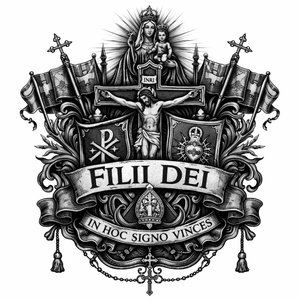
Hey Feminists - No means No.
Every few years, like clockwork, someone rediscovers the question of women's ordination. A panel is convened. A strongly worded op-ed appears. A synod working document includes the phrase "listening to voices." And everyone acts shocked, shocked, when Rome gives the same answer it gave the last time, and the time before that, and roughly every time since the Last Supper.
So let's try this one more time, slowly, with feeling.
The Parent Principle
Anyone who has raised children knows the routine. A seven-year-old asks if she can have ice cream for dinner. You say no. She asks again, this time with a pleading face. No. She asks Dad. Dad says no. She waits twenty minutes and asks again, on the theory that parental resolve, like a cell phone battery, drains over time. She tries rephrasing: "What if it's a small ice cream dinner?" She organizes her little brother into a coalition. She suggests that "the family is on a journey" regarding ice cream.
The answer is still no.
Now, a good parent doesn't just say "because I said so," although that is technically sufficient. A good parent explains: dinner is supposed to nourish you, and ice cream doesn't. The rule isn't arbitrary. It flows from what dinner is. But eventually, after the explanation has been given, repeated, written down, laminated, and stuck on the refrigerator, the parent is entitled to say: "We've discussed this. The answer is final. Please stop asking."
The Church has reached the refrigerator-lamination stage.
The Explanation (Yes, There Is One)
Contrary to popular belief, the Church's answer isn't "girls are icky." A priest isn't just a guy who's good at public speaking and remembers where the thurible is kept. At the altar, the priest acts in persona Christi, in the very person of Christ (Catechism 1548). He doesn't say "This is Jesus's body." He says "This is my body." He is a living sacramental sign of Christ.
And signs have to actually signify. You can't baptize with orange juice, and you can't consecrate a bag of Doritos, no matter how sincere you are. The sacraments use natural things that naturally point to what they mean.
What does the priest point to? Christ the Bridegroom. Scripture is relentless on this: "Husbands, love your wives, as Christ loved the church and gave himself up for her" (Eph 5:25, RSV-2CE). The whole story ends at a wedding: "the marriage of the Lamb has come, and his Bride has made herself ready" (Rev 19:7). At Mass, Christ the Groom gives himself to his Bride, the Church. The priest images the Groom. Everyone else, men included, is the Bride. (Yes, gentlemen, that means you too. Deal with it.)
Natural law already tells us that men and women are equal in dignity but not interchangeable. Swapping a woman into the bridegroom role doesn't make the sign more inclusive. It makes it a wedding with two brides and no groom, which, as a sacramental sign, communicates approximately nothing.
And before anyone cries sexism: the greatest human person who ever lived, the Blessed Virgin Mary, was never ordained. She seems to have managed.
"But Maybe the Next Pope…"
No.
In 1994, Pope St. John Paul II issued Ordinatio Sacerdotalis, declaring that the Church "has no authority whatsoever" to ordain women, and that this judgment is to be "definitively held by all the Church's faithful." Note the word definitively. It is not a synonym for "until further notice."
Then, because people immediately asked, "Okay, but is that really final?", the Congregation for the Doctrine of the Faith issued a Responsum ad Dubium in 1995, approved by the Pope, confirming the teaching belongs to the deposit of faith and has been set forth infallibly by the ordinary and universal Magisterium (see Lumen Gentium 25). In 1998, the CDF listed it among truths requiring definitive assent. Canon 750 §2 binds the faithful to firmly accept and hold such teachings. Pope Francis, hardly a reactionary, said John Paul II had the last clear word on the matter and that it stands.
In other words: asked, answered, laminated, refrigerated.
The Bottom Line
A Catholic doesn't get to treat a definitive teaching like a terms-of-service agreement, scrolling past to find the loophole. The door isn't closed because Rome is stubborn. It's closed because the Church never had the key. Christ has it.
So, to our friends still circling the rectory with petitions: we love you. We value you. Your gifts are real and the Church needs them.
But no means no.