Obtaining Expensive Paper doesn’t make you Educated…
In America, shortly after the Second World War, society agreed to a swindle. We agreed that a piece of paper, printed by an institution that charges more per year than most families make, and stamped with a Latin motto nobody on campus can translate, means the person holding it is educated. We do not ask what they know. We do not ask whether they can defend a claim, weigh a competing argument, or survive five minutes of Socratic pressure without collapsing into a heap of slogans. We just check for the diploma, nod respectfully, and move on.
It's time to stop doing that. It's time to our “higher education” what it really is: CREDENTIALING. Universities are not producing educated citizens. They are producing angry, entitled activists with formally respected credentials. Education and credentialing are not synonyms—they are separate categories wearing the same outfit.
Education, properly understood, is a discipline. It means learning to follow an argument wherever it leads, even when it leads somewhere uncomfortable. It means testing your assumptions against evidence, against history, against people who disagree with you and might be right. It means, at minimum, being able to state the strongest version of the other side's position before you reject it. That is what education has meant from Aristotle to Aquinas to the one-room schoolhouse. It is not a mysterious or complicated standard. It's just rigorous. Educated people are not always in possession of fancy, frameable paper. And, education doesn’t mean using 20 words in a sentence where 4 words will do.
Credentialing is a different animal entirely. Credentialing means sitting through four (or six, or ten) years of lectures, absorbing an approved vocabulary, reciting it back on command, and paying an enormous sum for the privilege of being certified as having done so. Nobody checks whether you can think. They check whether you can perform. And the performance, on nearly every campus in this country, has narrowed to a single script.
Here's the part the modern university would very much prefer you forget: it didn't invent itself, and it certainly didn't invent the pursuit of truth. The university, as an institution, is a Catholic invention and was ordered to the pursuit of Truth. Bologna in 1088, Paris not long after, Oxford trailing behind them—these were not secular startups that stumbled into theology by accident. They were chartered by popes and bishops, staffed by monks and clerics, built explicitly as a studium generale: a place ordered toward the discovery of Truth, with the arts faculty as the foundation and theology sitting at the top as the "queen of the sciences," because the medieval mind understood something the modern mind has conveniently unlearned—you cannot properly organize your knowledge of anything until you've settled the question of what, or Who, reality ultimately answers to. Aquinas did not see faith and reason as enemies to be smuggled past each other. He saw them as two rivers running from the same source, and he built an entire architecture of thought on the assumption that truth exists, is unified, and can be pursued honestly wherever it leads—Aristotle's logic and the Gospel's revelation included.
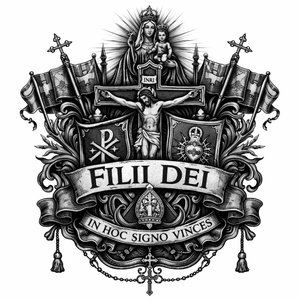
That is not incidental trivia. That is the entire reason the institution exists. And it's why the joke of the Latin motto lands so hard. Harvard's shield still says Veritas. Yale's says Lux et Veritas—light and truth. Princeton's says the university flourishes under the will of God. Every one of these schools was founded, often quite explicitly, to train men who could know God's truth and reason rightly about His creation. Go ahead and say that sentence to a Harvard freshman orientation seminar today and watch the confusion on their faces. It’ll be as if you've addressed them in a dead language, which, functionally, you have. The motto is still stitched onto the sweatshirt. Nobody bothered to preserve the thing it names.
The reason is simple. Somewhere over the last century, the university did something no institution should ever survive doing: it kept the buildings, kept the tuition, kept the Latin on the crest, and quietly abandoned the premise that Truth is real, objective, and knowable. Once a faculty stops believing there is a truth out there to discover and "truth" gets demoted to a rhetorical trick used by whoever currently holds power—there is exactly one category of analysis left standing to explain anything: power. Who has it, who wants it, who's allegedly been denied it. It is not a coincidence of timing. It is a vacuum being filled precisely as fast as it opens. Rip the keel of objective truth out of the hull, and the ship doesn't sit still. It takes on whatever water is nearest, and the water nearest to a secularized, truth-abandoning academy was always going to be Marxism, because Marxism is the one system perfectly happy to operate with no truth at all except the truth of who is oppressing whom. A Catholic university has to argue that reality has a shape and a Creator. A post-truth university doesn't have to argue anything. It just has to assign power scores.
You already know the script. You've heard it from every valedictorian speech, every diversity statement, every "lived experience" panel, every syllabus with a land acknowledgment bolted on the front like a hood ornament. Power is the only real category of analysis. Every hierarchy is oppression in disguise. Merit is a myth invented by the powerful to justify their power. The market is theft, the family is a cage, the nation is a fiction, and the whole of human history is one long story of oppressors and oppressed with the professor, naturally, on the side of the oppressed. Strip away the vocabulary—the "structures," the "praxis," the "hegemony," the footnotes to French theorists nobody can actually explain—and you are left with a single idea, repeated in a thousand costumes: Marxism.
It isn’t always the Marxism of five-year plans and gulags, mind you. Sophisticated people will tell you, with real condescension, that they're not that kind of Marxist. But, news flash, they’re ALL that kind of Marxist. Strip the economics down to its skeleton and what's left is the same instinct dressed for a different party: the world is best understood as a struggle between an oppressor class and an oppressed class, and justice means transferring power from the former to the latter by whatever means are available, law included. Swap "bourgeoisie and proletariat" for "privileged and marginalized" and you have not changed the argument. You've simply changed the wardrobe.
Here is the part that should embarrass everyone involved: none of it survives actual scrutiny. It doesn't survive economic history, which shows markets lifting billions out of poverty while every serious attempt at command economics has produced shortage, stagnation, and secret police. It doesn't survive plain observation of the family, which remains—despite a hundred years of theorists insisting otherwise—the institution most correlated with a child's flourishing. It doesn't survive a fair reading of the tradition it claims to supersede, a tradition built by people who thought considerably harder about virtue, law, and the human person than anyone currently drawing a university salary. And, it certainly does not survive the application of the very tools education is supposed to instill: skepticism of unfalsifiable claims, respect for evidence over feeling, and the willingness to ask an inconvenient question twice.
That is the tell. An idea this fragile cannot be taught. It can only be installed. And installation requires exactly what our universities now specialize in: repetition without rebuttal, grading that punishes dissent, faculty homogeneity from one side of every live political question, and at least four years of intense, threatening social pressure engineered to make disagreement feel like cruelty.
That is not a curriculum. That is a factory setting.
Ask yourself why a genuinely confident idea would need any of that machinery. Catholicism survived three centuries of Roman persecution and came out the other side stronger, because it could be argued for in the open, in front of hostile audiences, without the emperor's help. The American founding was debated, ratified, and re-argued by men who expected opposition and answered it point by point. Real ideas invite the fight. They don't need a captive audience of eighteen-year-olds, a locked classroom, and a grading rubric to survive contact with an opponent. The fact that modern academic radicalism cannot be exposed to a fair fight—that it requires a monopoly on the microphone and a thumb on the scale of every grade—is not evidence of its strength. It is a confession of its weakness.
So let's retire the flattering word. A doctor who can diagnose, a lawyer who can argue both sides of a case, a craftsman who can build something that doesn't fall down—those people are educated, whatever paper they hold or don't. But the twenty-two-year-old who graduates certain that the whole of Western civilization is a conspiracy of the powerful, who cannot name a single serious argument against her own position, who has never once been asked to defend an idea against a professor actually willing to push back—that person has not been educated. She has been processed. She has been credentialed. And, as the final exam, she will dutifully calculate that 2+2 = 5 and recite that a man can become a woman.
Call it what it is, and the emperor's new clothes fall off fast. A credential tells you someone paid the tuition and said the words. It tells you nothing about whether they can think. The moment we stop confusing the two—the moment "educated" once again means what it used to mean—the whole machine loses its authority, because its authority was never earned. It was stolen from a word it no longer deserves.
And if these institutions ever want the word back, the path isn't a mystery. It's stitched right there on the crest they still peddle in the gift shops without irony. Veritas. Truth. They need to go discover it. Until then, they can keep their $100.00 sweatshirt.