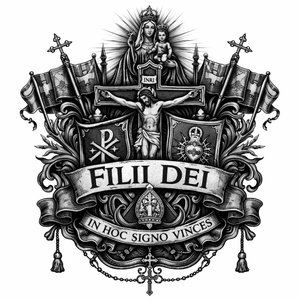
Roma Aeterna - The Kingdom that shall not be destroyed…
Often, you will hear some who castigate the Catholic Church try to use—as a perjorative—the “Roman Catholic Church.” It is a moniker we should adopt not only with pride but with glee. The Church has always called herself Catholic, but she has never called herself merely Catholic. From the patristic age onward she is the Roman Catholic Church — not because Rome happens to be where a bureaucracy settled, but because Roman location is bound up with the very content of the prophecy she fulfills. Daniel's vision of the four kingdoms and the stone cut without hands is not background scenery for ecclesiology; read according to the unbroken mind of the Fathers, it is a title deed. And that title deed names Rome, not Jerusalem, as the place where the everlasting kingdom stands — a kingdom, moreover, that Daniel himself calls indestructible and perpetual, "which shall never be destroyed... and it shall stand for ever."¹
I. The Fourth Kingdom and the Stone
Nebuchadnezzar's statue of gold, silver, bronze, and iron represents four successive kingdoms — Babylon, Medo-Persia, Greece, and a fourth "strong as iron," which crushes and subdues all before it.² A stone, cut from a mountain "without hands," strikes the statue on its feet, shatters the whole image, and grows until it fills the whole earth.³ The parallel vision of Daniel 7 gives the same fourth kingdom teeth of iron and claws of bronze, devouring the whole earth, treading it down, and breaking it in pieces — and then declares that "the kingdom, and the power, and the greatness of the kingdom, under the whole heaven, shall be given to the people of the saints of the most High: whose kingdom is an everlasting kingdom."⁴
The patristic consensus, not merely one strand among several, identifies this fourth kingdom as Rome. Hippolytus, writing in the early third century while the empire still stood, states plainly that the iron kingdom is Rome, the last of the four before the eternal kingdom of the saints.⁵ St. Jerome, answering Porphyry's attempt to restrict the whole prophecy to Antiochus Epiphanes, insists that the fourth kingdom is unmistakably Roman — an empire, he notes, still ruling the world in his own day, distinguishing Daniel's prophecy from every merely local fulfillment claimed by the pagan critic.⁶ St. Cyril of Jerusalem, catechizing the newly baptized on the last things, likewise reckons Rome as the fourth kingdom whose dissolution will precede the revelation of Antichrist, a reading he treats as received rather than novel.⁷ This is not private opinion; it is the reading that governed Catholic exegesis for over a millennium, down through St. Thomas and the medieval commentators.
The stone, by contrast, is "cut without hands" — a kingdom not raised up by human statecraft, dynastic succession, or military conquest, but instituted directly by God.⁸ It becomes "a great mountain, and filled the whole earth" — not a rival empire operating alongside Rome in some other territory, but a kingdom that supplants the statue precisely where the statue stood.⁹ This detail is the whole argument in miniature: the stone does not land beside the fourth kingdom. It strikes it at the feet, on its own ground, and then expands to occupy the space the statue itself had filled.
II. Founded at Rome, Not Beside Rome
The Incarnation occurs under Caesar Augustus, within the political shell of the fourth kingdom, and the apostolic mission travels the roads and sea-lanes that Roman order made possible. Peter and Paul, having preached in the East, deliberately make their way to the capital of the very empire Daniel foresaw, and both are martyred there. St. Irenaeus, writing within living memory of the apostles, calls the Roman church "the greatest and most ancient church, known to all, founded and organized by the two most glorious apostles Peter and Paul," and teaches that every other church — indeed, the faithful everywhere — must agree with this church on account of its "more powerful preeminence" (potentior principalitas).¹⁰
The generations immediately following confirm the same instinct. St. Cyprian, contending against schism in the mid-third century, roots the Church's visible unity in the Chair first occupied by Peter, warning that whoever abandons that Chair abandons the promise of Christ to His Church.¹¹ Optatus of Milevis, writing against the Donatists a century later, appeals to the unbroken list of Roman bishops from Peter onward as proof of catholic communion, calling it the one "episcopal chair" (cathedra unica) with which all churches must be found in agreement, and daring his opponents to produce a comparable succession for their own altar.¹² The argument these Fathers make is not merely that Rome was an important church; it is that visible unity itself is structurally located there, the way a keystone is located at a particular point in an arch and nowhere else.
III. Providence, Empire, and the Baptism of the Fourth Kingdom
The stone does not annihilate the territory of the statue; it fills it. St. Augustine, surveying the whole sweep of Roman history in The City of God, argues that God raised up Roman virtue and Roman dominion providentially, as the human precondition for a single, pacified world into which the Gospel could be preached without hindrance — the empire's vices notwithstanding, its order was itself a kind of scaffolding for grace.¹³ Augustine goes further and draws the very typology this narrative suggests: he calls Rome, in the days of her pagan grandeur, "as it were a second Babylon," the second great imperial city of the earthly city's history, standing at both the beginning (Babylon) and the culmination (Rome) of the sequence of empires Daniel foresaw.¹⁴ Rome, in other words, was always going to be Babylon's successor in the order of empire — the only open question was whether she would also become Jerusalem's successor in the order of grace. The Gospel's arrival, and Peter and Paul's martyrdom on her soil, settled that question.
St. Leo the Great, preaching on the feast of the Apostles, makes the same point liturgically: the city made mistress of the nations by earthly conquest has become still greater by being made "the head of the world through the most holy See of blessed Peter," ruling now more widely by religion than she ever did by arms.¹⁵ The medieval instinct that Roman imperial authority is transferred rather than simply extinguished — culminating in the Carolingian and later the Holy Roman restoration of empire under papal sanction — is the political expression of the same theological fact: the fourth kingdom's Roman substance is not destroyed but taken up and consecrated.¹⁶
IV. Rome as the Restrainer
St. Paul teaches that a restraining power holds back the revelation of the Man of Sin until "he who now holdeth" is himself taken out of the way.¹⁷ Tertullian and St. John Chrysostom, representing the common patristic reading, identify this restrainer with the Roman Empire and its order: so long as Roman authority stands, the final Antichrist cannot appear.¹⁸ Cyril of Jerusalem makes the same identification explicit in his catechesis on Antichrist, treating the persistence of Roman government as the very thing Paul had in mind.¹⁹ St. Robert Bellarmine, writing in the great post-Tridentine controversial synthesis against the Reformers' identification of the Papacy itself with Antichrist, defends the older reading at length in his treatise De Antichristo, arguing that the restrainer is properly the Roman power — first imperial, then, in its Christian and papal continuation, the stabilizing office the Apostolic See exercises over the nations.²⁰ On this reading, the kingdom of Daniel cannot be relocated at will, because its eschatological function — restraining the last apostasy until the appointed hour — is tied to the very seat where imperial authority once resided and where Petrine authority now resides in its place.
V. The Babylon Difficulty, and Augustine's Answer
A fair objection must be met here. The Apocalypse itself repeatedly calls the great persecuting city "Babylon," and the early commentators — Victorinus of Pettau chief among them — read this Babylon as pagan Rome, drunk with the blood of the saints.²¹ If Rome is Babylon's heir in judgment, how can she also be the seat of the eternal kingdom? The answer lies in the very distinction Augustine draws between the civitas terrena and the civitas Dei — two loves, two cities, interwoven in this life within the walls of every earthly city, Rome included, until the final separation.²² Pagan Rome, the Rome of the Caesars who fed Christians to beasts, is Babylon in the Apocalypse's judgment — the earthly city in its most concentrated, most idolatrous, most bloodthirsty form. But that same geographic Rome, once converted, ceases to be Babylon precisely because the civitas Dei has, in the persons of Peter, Paul, and the martyrs who followed them, planted her visible center there and, in Leo's phrase, made the city's headship a religious rather than a merely military one.²³ The prophecy is not thereby contradicted; it is fulfilled twice over in the same city, first as judgment on the fourth kingdom's pride, then as the site of the fifth kingdom's foundation — Babylon fallen and Jerusalem descending occupying, in sequence, the identical ground.
VI. Why Not Jerusalem
Jerusalem held real primacy under the Old Covenant: the Temple, the priesthood, the sacrifice prefiguring Calvary. But that primacy was typological and provisional by its own design, oriented toward a fulfillment outside itself. Christ foretells the Temple's destruction in explicit terms,²⁴ and the fall of Jerusalem in A.D. 70 stands as the visible seal that the old economy's earthly center had completed its office; Eusebius records that the Jerusalem church itself, warned by revelation, withdrew across the Jordan to Pella before the city fell, a flight the Fathers read as the visible Church declining to be bound any longer to the doomed earthly capital.²⁵ The rending of the Temple veil at the crucifixion signals the same transfer in advance.²⁶
Nor does the New Testament establish a perpetual apostolic primacy fixed at Jerusalem. Peter presides there in the Church's infancy, but he does not remain; he goes to Rome and dies there, and it is Rome's church, not Jerusalem's, that the whole ancient world recognizes as possessing the chair from which unity flows. When the Apocalypse speaks of the eternal city of God, it does not point back to the earthly Zion but forward to a "new Jerusalem, coming down out of heaven,"²⁷ and St. Paul already distinguishes the earthly Jerusalem "which now is, and is in bondage" from "that Jerusalem which is above," which "is free: which is our mother."²⁸ The heavenly Jerusalem is a title the Church bears precisely because she is not the old, particular, national city, but the new, universal, gentile-embracing kingdom commanded to teach "all nations."²⁹ What Jerusalem prefigured under the shadow of the Law, Rome — purified by the blood of two Apostles and a multitude of martyrs — receives and perpetuates in visible, catholic form.
VII. The Chair Cannot Move: A Dogmatic and Historical Confirmation
The Church's own dogmatic teaching makes this fixity explicit rather than accidental. The First Vatican Council defines that Peter's primacy was to continue perpetually in his successors, and it identifies that perpetuity precisely with the Roman See, speaking of "whoever succeeds Peter in this See" as inheriting the primacy by Christ's own institution.³⁰ St. Robert Bellarmine, treating the same question in his systematic defense of the Papacy, argues at length that the union of the Petrine office with the Roman See, while not absolutely necessary in the abstract order of God's power, is nevertheless fixed by Christ's actual providential ordinance and by the Church's own uninterrupted practice, such that no council or pope may licitly sever the two.³¹
History itself supplied a dramatic confirmation of this teaching. During the Avignon papacy of the fourteenth century, St. Catherine of Siena wrote repeatedly and urgently to Pope Gregory XI, insisting in language of filial boldness that he return to "the See of the glorious Peter, which he left," precisely because the Bride of Christ was suffering for want of her true seat.³² The pope's eventual return to Rome in 1377, undertaken substantially through her intercession, was received by the Church as a restoration rather than a mere administrative preference — evidence that the theological instinct binding Peter's chair to Rome specifically, and not to wherever a pope might reside, was operative in the Church's own lived self-understanding centuries before Vatican I made it formal doctrine. The twentieth-century excavations beneath the high altar of St. Peter's Basilica, which uncovered an ancient tomb venerated since at least the second century as the Apostle's own and which Pope Pius XII and later Pope St. Paul VI announced had yielded relics consistent with Peter's burial, only deepen the same point in the order of physical fact: the kingdom's visible center rests, quite literally, on the bones of the man to whom the keys were given.³³
VIII. In Summary
Read through the constant mind of the Fathers, the later definitions that formalize their reading, and the Church's own lived history, Daniel's prophecy yields a single conclusion: the stone cut without hands strikes the fourth, iron kingdom on its own ground and grows into the mountain that fills the whole earth from that same ground. That kingdom is the Catholic Church, and the ground is Rome — not a Rome left as conquered wreckage, but a Rome once Babylon in her pride, baptized, made the perpetual See of Peter, and charged with restraining the final apostasy until the Lord's return. Jerusalem's vocation was real, but it was consummated and transcended, not perpetuated, in the "Jerusalem which is above." The Church is Roman, then, not by the accident of where the popes eventually settled, but because Rome is where the fifth and final kingdom of Daniel's vision was providentially planted, twice vindicated against her own former idolatry, and where, by dogmatic definition, sacred tradition, and the very stones beneath St. Peter's, it will remain until the end of the age. I’ll bet you won’t hear any of that at Pastor Phil’s Fun Time Family “Non-Denominational” Church…
Endnotes
1. Dan. 2:44.
2. Dan. 2:31–40.
3. Dan. 2:34–35.
4. Dan. 7:7, 7:19–23, 7:27.
5. Hippolytus, Commentary on Daniel, IV.5–9 (identifying the fourth kingdom of both the statue and the beasts as Rome, "the iron kingdom" reigning "now").
6. St. Jerome, Commentary on Daniel, on Dan. 2:40 and 7:7, written explicitly against Porphyry's restriction of the prophecy to the Seleucids, and affirming that "the fourth kingdom, which clearly belongs to the Romans, is the iron empire which crushes and subdues all things."
7. St. Cyril of Jerusalem, Catechetical Lectures, XV.12–17 (on the signs preceding Antichrist, reckoning the Roman power as the last kingdom of Daniel's series).
8. Dan. 2:34, 2:45 ("a stone was cut out of the mountain without hands").
9. Dan. 2:35.
10. St. Irenaeus, Adversus Haereses, III.3.2.
11. St. Cyprian, De Unitate Ecclesiae Catholicae, 4–5.
12. Optatus of Milevis, De Schismate Donatistarum, II.2–3 (on the cathedra unica and the succession of Roman bishops from Peter).
13. St. Augustine, De Civitate Dei, V.12–19 (on Roman virtue, the love of glory, and providence); cf. XVIII.22 on the Pax Romana as the temporal condition for the Gospel's spread.
14. St. Augustine, De Civitate Dei, XVIII.2, comparing Rome to a "second Babylon," the second and culminating city of empire in the sequence Daniel foresaw.
15. St. Leo the Great, Sermon 82 (On the Feast of Ss. Peter and Paul), 1–3.
16. On the medieval theology of translatio imperii as the Christianized continuation of Roman authority, see the coronation theology surrounding Charlemagne (800) and Otto I (962), and its later canonical development.
17. 2 Thess. 2:6–7.
18. Tertullian, Apologeticum, 32; St. John Chrysostom, Homilies on Second Thessalonians, Homily IV.
19. St. Cyril of Jerusalem, Catechetical Lectures, XV.11 ("he speaks of the Roman Empire").
20. St. Robert Bellarmine, Disputationes de Controversiis Christianae Fidei, Controversia Tertia Generalis (De Summo Pontifice), Bk. III, De Antichristo, chs. 3–4.
21. Victorinus of Pettau, Commentary on the Apocalypse, on Apoc. 17:9–10, identifying the seven-hilled harlot city with pagan Rome.
22. St. Augustine, De Civitate Dei, I, Praef., and XIV.28 (the two loves that build the two cities, intermingled in this life).
23. St. Leo the Great, Sermon 82, 1 (Rome made head of the world "through the most holy See of blessed Peter").
24. Matt. 24:2; cf. Luke 21:20–24.
25. Eusebius of Caesarea, Historia Ecclesiastica, III.5.3, on the Jerusalem church's flight to Pella before the city's fall.
26. Matt. 27:51.
27. Apoc. 21:2, 21:10.
28. Gal. 4:25–26.
29. Matt. 28:19.
30. First Vatican Council, Pastor Aeternus (1870), ch. 2, "On the Perpetuity of the Primacy of Blessed Peter in the Roman Pontiffs."
31. St. Robert Bellarmine, De Romano Pontifice (within the Disputationes de Controversiis), II, on the providential and practical, though not absolutely metaphysical, necessity binding the Petrine office to the See of Rome.
32. St. Catherine of Siena, Letters, e.g. Letter 206 to Pope Gregory XI, urging his return to Rome and the See of St. Peter.
33. Pope Pius XII, radio address of 23 December 1950, announcing the results of the excavations beneath St. Peter's Basilica; Pope St. Paul VI, address of 26 June 1968, announcing the identification of relics believed to be those of St. Peter. See also Margherita Guarducci, The Tomb of St. Peter (1960), for the archaeological findings.