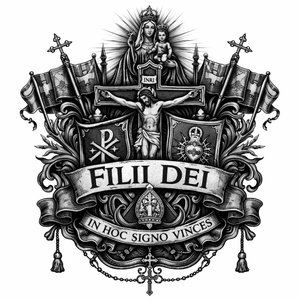
Religious Symbolism and the Nasal Septum Ring - An observation…
There was a time when religious symbols actually meant something. A crucifix represented sacrifice, suffering, obedience, transcendence, and the uncomfortable reality that the universe does not revolve around your personal feelings. Naturally, modern leftism had to replace it with something more appropriate to its theology. And so, for women aged 18–45 who identify as “spiritual,” “queer-adjacent,” or “politically activated,” we now have the nasal septum ring—the sacred relic of the Progressive Church.
The septum ring is not jewelry. That is a naïve and frankly offensive misunderstanding. It is a creed. It is a sacrament. It is a public profession of faith, worn prominently in the middle of the face like a liturgical declaration: “I reject all inherited meaning and have replaced it with my authenticity.”
Just as the crucifix once silently preached Christ crucified, the septum ring now preaches a different gospel. Its message is clear: I am morally superior, emotionally fragile, and deeply offended by your tone. No words required. One glance, and you know exactly where this person stands on every issue—from climate change to microaggressions to why masculinity is a toxic social construct but femininity is sacred and untouchable.
In traditional Catholicism, the crucifix was worn as a reminder of humility. The septum ring serves the opposite function. It is not about humility; it is about declaration. It says, “Look at me. Validate me. Ask me about my trauma. Affirm my identity. Do not challenge me, but do listen—at length—while I explain why I am right and you are wrong.”
It is worn, notably, in the most biologically impractical location possible. This is not accidental. Like all religious symbols, it reflects theology. The septum ring subtly communicates disdain for practicality, aesthetics, and natural order. It is rebellion distilled into metal. Where God once ordered creation toward beauty and harmony, the septum ring boldly announces, “Actually, disorder is more authentic.”
Every religious system has its saints. In the Progressive Church, Saint Billie of Eilish and Saint Greta of the Blessed Sailboat serve as icons, their images revered, their aesthetic emulated. Their followers mark themselves accordingly—not with ashes or holy water, but with stainless steel hoops, usually purchased during a period of intense self-discovery that suspiciously coincides with sophomore year.
There is also, of course, the ritual significance. The septum ring is often acquired during a pilgrimage—commonly to a tattoo parlor with exposed brick walls and a name like Iron Bloom Collective. The ceremony involves fluorescent lighting, gender-neutral bathrooms, and a piercing artist who looks like they escaped from a Portland, OR sociology seminar. Pain is involved, but this pain has meaning. It is redemptive. It proves seriousness. It separates the faithful from the normies.
And like all religious symbols, the septum ring also functions as a boundary marker. In the same way early Christians identified one another through symbols during persecution, progressive women use the septum ring to identify allies in the wild—at coffee shops, bookstores, ICE protests, and HR departments. It signals safety. You may now discuss astrology, trauma, and why capitalism is violence without fear of disagreement. Hatred for parents is implied.
Critics will say this is unfair. They will insist the septum ring is merely fashion, personal expression, or cultural appropriation depending on the day. But this defense collapses under even casual observation. No other fashion accessory correlates so perfectly with a belief system. You will never meet a woman with a septum ring who thinks children need fathers, reality is objective, or maybe—just maybe—Western civilization got a few things right.
And like the crucifix, the septum ring invites reverence from the faithful and mockery from heretics. To question it is to commit blasphemy. To suggest it looks bad is an act of violence. To wonder aloud why so many emotionally identical people all chose the exact same “individual expression” is to summon cries of oppression.
In the end, the septum ring is not about rebellion. True rebellion requires courage. This is conformity with better marketing. It is the uniform of a worldview that claims to reject dogma while enforcing it ruthlessly, that mocks religion while inventing its own, complete with symbols, rituals, saints, and heretics.
The old crucifix said, “Pick up your cross and die to yourself.”
The new one says, “Pick a pronoun and demand applause.”
Different gods. Same instinct.