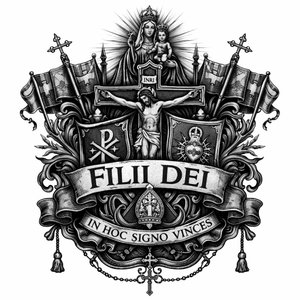
THEME — What We Shall Be: Children of God, Already and Not Yet
On the Solemnity of All Saints the Church lifts our eyes to the end of the road. The Mass presents three pictures of one reality: the unnumbered multitude before the throne, the children of God who are already what they have not yet fully become, and the portrait of the blessed in the Beatitudes. Together they answer a question every believer eventually asks: what is all of this for?
The answer is stated plainly in the Second Reading: we shall see him as he is. The saints are not a spiritual elite. They are the people who arrived at the end for which every baptized person was made. Because All Saints falls on a Sunday this year, the solemnity takes the place of the Thirty-First Sunday in Ordinary Time, and the whole parish hears the call to holiness addressed to it directly.
The Responsorial Psalm gives the refrain that frames the day: Lord, this is the people that longs to see your face. The saints are defined by longing, and the feast asks whether we share it.
READINGS
First Reading: Revelation 7:2–4, 9–14
Responsorial Psalm: Psalm 24:1b–2, 3–4ab, 5–6
Second Reading: 1 John 3:1–3
Gospel: Matthew 5:1–12a
FIRST READING — REVELATION 7:2–4, 9–14
The Sealed and the Multitude
An angel ascends from the east bearing the seal of the living God and commands that the earth not be harmed until the servants of God are sealed on their foreheads. One hundred forty-four thousand are sealed, twelve thousand from each tribe of Israel. The tradition reads the number as symbolic: the fullness of God's people, complete and ordered.¹
Then the vision widens. John sees a great multitude, which no one could count, from every nation, race, people, and tongue, standing before the throne and the Lamb, wearing white robes and holding palm branches. The sealed and the multitude are one people seen from two sides, first marked as belonging to God and then gathered in victory. The seal is the mark of ownership that the Church recognizes in baptism and confirmation.
An elder then identifies them: these are the ones who have survived the time of great distress; they have washed their robes and made them white in the blood of the Lamb. The paradox is deliberate. Blood does not whiten a robe by ordinary logic; grace does what nature cannot. No one in that multitude earned their whiteness by never being stained. They were cleansed. Every saint is a forgiven sinner, and the difference between a saint and the rest of us is what was done with the cleansing.
The worship that follows is instructive. The multitude attributes salvation to our God, who is seated on the throne, and to the Lamb. The saints do not point to themselves in heaven. Their glory is a display of what God has accomplished.
SECOND READING — 1 JOHN 3:1–3
Already Children, Not Yet Revealed
John opens with wonder: See what love the Father has bestowed on us that we may be called the children of God. And so we are. The last clause matters. Sonship is not a metaphor for a future status; it is a present fact conferred in baptism.
Yet what we shall be has not yet been revealed. The Christian lives in the tension between the already and the not yet. We are children now, and we are being conformed to the Son. When He appears, we shall be like him, for we shall see him as he is. Augustine saw in this verse the whole structure of Christian hope: vision transforms, and the present life is a training of the heart's eye for the vision of God.²
John then draws the practical consequence: Everyone who has this hope based on him makes himself pure, as he is pure. Hope here is no sentiment. It is a reason to act. A person who truly expects to see God begins preparing the eyes.
GOSPEL — MATTHEW 5:1–12a
The Beatitudes: The Face of the Saint
Jesus goes up the mountain, sits as a teacher, and begins the new Law with blessings rather than commands. The poor in spirit, the meek, those who mourn, those who hunger and thirst for righteousness, the merciful, the clean of heart, the peacemakers, and the persecuted: these are named blessed. Aquinas treats the Beatitudes as the acts of perfected virtue and the rewards promised to them, a beginning of heavenly happiness that starts already on earth.³
The first and the eighth promise the kingdom in the present tense, framing the whole list as a present reality. The others look forward to comfort, inheritance, satisfaction, mercy, the vision of God, and the title of children of God. That last promise connects the Gospel to the Second Reading: the peacemakers will be called children of God, and the clean of heart will see God. The Church assigns these texts together because they describe the same destination from different angles.
The saints are the people in whom the Beatitudes were lived to the end. The final blessing is the most personal: Blessed are you when they insult you and persecute you and utter every kind of evil against you falsely because of me. Rejoice and be glad, for your reward will be great in heaven. Fidelity to Christ will cost something in this world, and that cost is a sign of belonging rather than defeat.
THEOLOGICAL SYNTHESIS — THE COMMUNION OF SAINTS
The three readings supply three aspects of one doctrine. Revelation shows the saints in glory. First John shows the identity that makes glory possible: adoption as children. Matthew shows the road: the Beatitudes as the shape of a life conformed to the Son.
From this follow three truths. The saints intercede, because the multitude before the throne is part of the same family and has not forgotten it. The saints exemplify, because each canonized life is the Beatitudes in a particular accent, which removes the excuse that holiness is impossible in our state of life. And the saints prove that grace is sufficient, since the multitude shares no common talent, century, temperament, or vocation, only a surrender that finished what baptism began.
The Second Vatican Council named this the universal call to holiness: all the faithful, in whatever state or rank, are called to the fullness of the Christian life and the perfection of charity.⁴ The doctrine is older than the phrase, and this solemnity has proclaimed it every November 1. It is worth noticing what the doctrine excludes. It excludes the notion that holiness belongs to clergy and religious while the laity manage ordinary respectability. It excludes the notion that sanctity depends on temperament. And it excludes the quiet assumption that the saints are admired rather than imitated.
PRACTICAL APPLICATION
On claiming the vocation. Say it plainly in prayer this week: I am called to be a saint, in my state of life, in this home and this job. Then name one concrete way your present duties (spouse, parent, worker, neighbor) are the actual road by which you are meant to arrive. Holiness will not be found in a different life than the one you have.
On the Beatitudes as an examination. Take one a day this week and ask where you stand. Where am I poor in spirit, and where am I claiming credit I have not earned? Where am I meek, and where am I defending my rights at others' expense? Whom have I refused mercy? Where have I broken peace and called it honesty? You will find one or two that expose you at once. That is the one to practice first.
On purifying the hope. John says that everyone with this hope makes himself pure. Pick one habit that dims your sight of God (a screen, a grudge, a private indulgence, a company you keep) and begin removing it. A person who expects to see God cannot be casual about his eyes.
On choosing a patron. Choose or renew devotion to a saint whose life speaks to your particular struggle. Read one short biography this month and ask for intercession by name, daily, for one specific need. The communion of saints works through relationship, and relationships need attention.
On the white robe. The multitude washed their robes in the blood of the Lamb. The practical meaning is the sacrament of Reconciliation. If it has been a long time, the robe has been getting dirty. Go this week. A feast of the saints is the right time to be among the forgiven.
On the cultural Catholic and the saint. The cultural Catholic and the saint share a baptism. One treats the faith as a descriptor; the other treats it as a rule of life. Every saint on the calendar began as an ordinary person who decided the Beatitudes meant what they said.
CONCLUDING MEDITATION — WE SHALL SEE HIM AS HE IS
The multitude is unnumbered because the Church does not know all its members. Most saints were never canonized: grandmothers, mechanics, nuns who never left the cloister, fathers who worked and prayed and died in grace.
They stand before the throne, robes washed, palms in hand, longing satisfied.
What they did was not extraordinary in kind. They accepted the seal, kept the Beatitudes as best they could, returned to the blood of the Lamb when they failed, and persevered.
The solemnity does not ask us to admire them. It asks us to join them.
Lord, this is the people that longs to see your face.
ENDNOTES
Bede, Explanatio Apocalypseos, on Rev. 7:4 (the 144,000 as the perfected fullness of the elect, symbolic rather than arithmetic).
Augustine, In Epistolam Ioannis ad Parthos, Tract. IV (vision as the reward and the transformation of the heart's desire).
Aquinas, Summa Theologiae, I-II, q. 69 (the Beatitudes as acts of perfected virtue and their rewards as a beginning of heavenly happiness).
Second Vatican Council, Lumen Gentium, §§39–42 (the universal call to holiness).