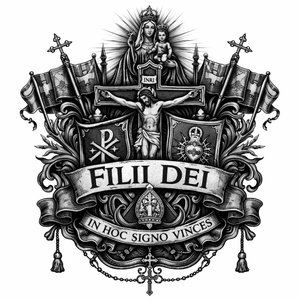
AI Doesn’t Make Art. The Soul Does.
Let's start with a confession. Every article I write has an image created by some chatbot. For this article, the prompt was: “Read the attached and create a title image for an article who’s title is: AI Doesn’t Make Art. The Soul Does.” If I said “create an image of the crucifixion,” what I might get back will look like a wax museum exhibit that had been left too close to a space heater. Christ will have six fingers on one hand. The centurion might appear to be melting into the ground like something out of a horror film. And yet somewhere, right now, a man in a hoodie in San Francisco is telling you this is the future of art. He is telling you that the thing that produced a mutant Christ with a spare thumb is the heir to Michelangelo. I want you to sit with how insane that is for a moment, because I’m are about to explain, exactly why it is insane — and why it was never going to be otherwise.
Here is the claim we are up against: that art is simply information processing. Rearrange enough pixels according to a statistical model trained on the labor of real human beings, and — presto — you have created something. But, art and creation is not simply a technological claim. It is a metaphysical claim. And, art and creation as information processing alone happens to be false. It is false because it denies the single fact that makes art possible in the first place: man is not merely a very complicated calculator.
Man has a soul.
I know. I know. Saying "soul" out loud these days gets you looked at like you just told someone you believe in the tooth fairy. We live in a culture that has spent two centuries trying to convince itself that a human being is nothing but chemistry with better lighting. So of course the same culture now looks at a chatbot spitting out plagiarized pastiche and says, "why not? It's basically the same thing we are." That is not an insult to the machine. That is the culture—and humanity—devaluing and insulting itself.
The Catholic Church has never accepted this. Long before anyone had heard of a "large language model," St. Thomas Aquinas, in large amounts of language, had already laid out, with more precision than any Silicon Valley white paper will ever manage, what a human being actually is: a rational animal, composed of body and an immortal, spiritual soul that is the substantial form of that body.1 It’s not a ghost riding around in a meat machine. It’s not an emergent property of neurons. It’s a soul — the principle by which the intellect knows universal truths and the will freely chooses the good.2 That is not a metaphor Aquinas threw in for flavor. It is the whole ballgame. Without an intellect that can grasp the why behind the shape of a thing, and a free will that can choose to give that vision form for the glory of God, you don't get art. You get output.
And here's the part the tech evangelists desperately do not want you to think about: beauty is not a vibe. Beauty is not "whatever the algorithm's aggregate training data suggests will get the most engagement." Beauty, according to the Angelic Doctor, is a transcendental — a property of being itself, convertible with truth and goodness, and ultimately identical with God, in whom truth, goodness, and beauty are one simple, infinite act.3 When Michelangelo carved the Pietà, he was not "generating an image." He was participating, in a finite and creaturely way, in the very beauty of God, because he possessed the one thing that can participate in anything at all: a rational soul made in the image of God.4 A server farm in Iowa possesses nothing. It has no image of God to speak of, because it has no being of its own — it has electricity and access to other people's stolen work.
This is where the "AI art" cheerleaders always want to change the subject to technique. "But look how realistic the lighting is!" Sure. And a taxidermied deer looks realistic too. Nobody worships it. Realism was never the point. The Church has never taught that art is measured by verisimilitude — a child's crude drawing of the Holy Family given to a parent is art, and a photorealistic image assembled by a machine can be nothing but noise, because the difference isn't in the pixels. It's in whether there is an intellect behind them that beheld something and willed to give it form. Pope St. Pius X spent an entire pontificate warning the Church about Modernism — the error of collapsing objective, transcendent truth into subjective feeling and process.5 AI art is Modernism's final form: not merely denying that beauty points to God, but denying there's anyone home to do the pointing at all.
Consider what the machine is actually doing when it "creates." It has no creative intuition, no interior life, no preconscious spiritual depths out of which genuine artistic inspiration is drawn — what Jacques Maritain, writing well before the Council, called the soul's "spiritual unconscious," the hidden root from which poetic knowledge flows.6 The machine has none of that. It has weighted probabilities derived from scraping the copyrighted labor of actual ensouled human beings, then reassembling fragments of it according to which arrangement statistically resembles what came before. That's not creation. That's a very expensive photocopier with a thesaurus.
And notice something else: the machine cannot suffer, cannot love, cannot repent, cannot kneel. Every great work of Catholic art that has ever pierced your heart — the Sistine ceiling, the Stabat Mater, the rose windows of Chartres — was wrung out of a soul that had wept, adored, and hoped. Bach signed his manuscripts Soli Deo Gloria because he knew, as every real artist has always known, that art is an act of worship offered by a creature to its Creator.7 A chatbot cannot offer God anything. It cannot love Him, so it cannot glorify Him, so whatever it produces — no matter how many fingers it eventually learns to draw — will never be a prayer. It will only ever be a very sophisticated forgery signed by no one, because no one was there.
So the next time someone tells you the machine is "creating," ask them a simple question: does it have a soul? If they say yes, they've just committed heresy against reason itself. If they say no — and they will, because they know it's true — then ask them how something with no soul, no intellect, no will, and no love could possibly do the one thing that has always required all three.
Now let me stop joking for a moment, because underneath the jokes is something I actually need you to hear. That question — why can't the machine create art — is not a trivia question. It is a mirror. It is the culture, whether it knows it or not, asking itself the only question that has ever mattered:
What am I?
A hundred years ago you didn't need a philosophy degree to answer that. Everyone knew, at least in their bones, that they were an ensouled creature made for God. Today we have built machines that flatter our own confusion back at us, and millions of people looking at a mangled six-fingered image of the Crucifixion are genuinely unsure whether something sacred just happened. That uncertainty is not a technology problem. It is a soul problem—a humanity problem— and it did not start with AI — AI is simply the bill caming due. If you cannot say, clearly and without hesitation, why a machine cannot do what you do — if the reason doesn't come immediately to your lips — then you have already absorbed more of the lie than you think, and the work in front of you is not learning to prompt a chatbot better. It is remembering, urgently and on your knees if necessary, that you are not one. We cannot lose our humanity to a server farm in Iowa. But, if we do, we are going to lose it the old-fashioned way — by forgetting what we were made for until there's nothing left distinguishing us from our tools. So, you MUST answer the question. Your soul and the souls of the generations after you depend on it.
Endnotes
1. St. Thomas Aquinas, Summa Theologiae, I, q. 75, a. 4; q. 76, a. 1 — the soul as the substantial form of the body.
2. Summa Theologiae, I, q. 79 (the intellect) and I, q. 83 (free will as a power of the rational soul).
3. Summa Theologiae, I, q. 5, a. 4, ad 1; I-II, q. 27, a. 1, ad 3 — beauty as a transcendental convertible with being, truth, and goodness.
4. Pope Leo XIII, Aeterni Patris (1879), on the restoration of Christian philosophy according to St. Thomas as the foundation for right reasoning about man and creation.
5. Pope St. Pius X, Pascendi Dominici Gregis (1907), on Modernism's reduction of objective truth to subjective religious experience.
6. Jacques Maritain, Art and Scholasticism (1920) and Creative Intuition in Art and Poetry (1953), on the soul's "spiritual preconscious" as the wellspring of authentic artistic creation.
7. Reginald Garrigou-Lagrange, O.P., The Three Ages of the Interior Life (1938), on the ordering of the human soul's faculties toward God as the final end of all authentic human acts, including artistic creation.