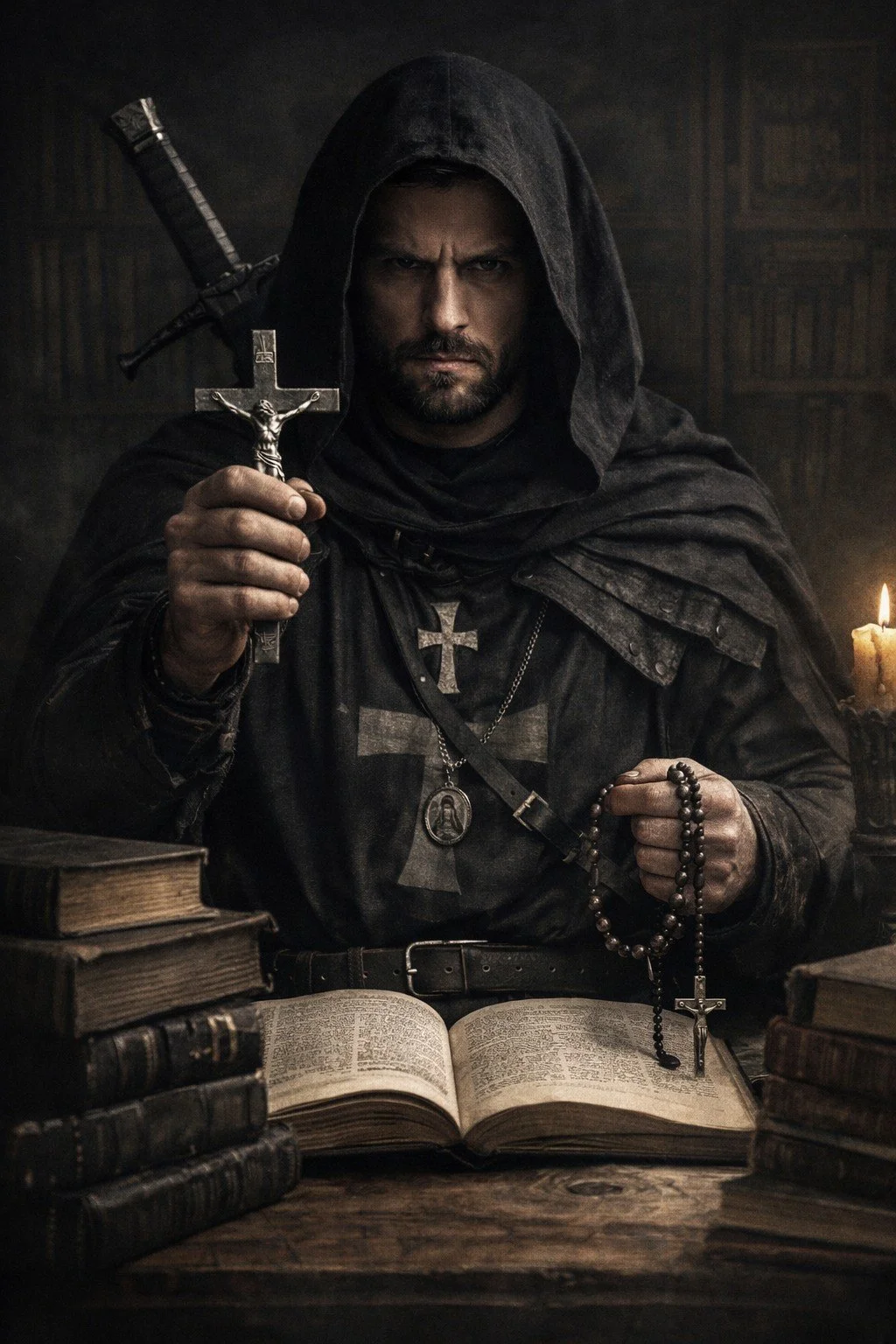
Religion - Defined.
Recovering a Forgotten Definition
Modern discussions of religion tend to reduce it to subjective experience, cultural affiliation, or therapeutic spirituality. Such approaches, while common, represent a radical departure from the classical Catholic understanding. For St. Thomas Aquinas, religion is neither an emotion nor a sociological phenomenon. It is a moral virtue, a stable habit of the will by which man is ordered to render God the honor, reverence, and worship that justice demands.
In the Summa Theologiae II-II, q.81, Aquinas defines religion as that virtue “whereby man offers something to God as though acknowledging Him as the source of all good.” This definition is precise, demanding, and profoundly countercultural. It insists that religion concerns what God is owed, not what man finds meaningful.
This article will examine Aquinas’s teaching on religion, integrating Scripture, the Catechism of the Council of Trent, and papal teaching, while explaining why each element is necessary for the integrity of Christian life, worship, and social order.
I. Religion as a Moral Virtue Under Justice
Aquinas places religion under the cardinal virtue of justice, which renders to each what is due. While God cannot be repaid proportionately—since He is infinite—man is nonetheless obligated to offer Him reverence, obedience, and worship according to his nature and capacity.¹ Religion is therefore a habitual orientation of the will toward fulfilling this obligation.
This placement is decisive. Religion is not optional, aesthetic, or merely inspirational. It is a moral duty grounded in natural law. As creature to Creator, man owes God acknowledgment of His sovereignty and goodness. Failure in religion is thus a failure in justice, not merely a personal preference.
Why this is necessary
If religion is not a virtue of justice, it becomes negotiable. Worship is reduced to taste, prayer to self-expression, and obedience to divine law to personal discernment. Once religion is severed from justice, God is no longer owed anything; He becomes a concept to be consulted rather than a Lord to be obeyed. Aquinas’s framework prevents this collapse by rooting religion in moral obligation rather than sentiment.
II. Religion as a Habit of the Will, Not a Passing Act
Aquinas insists that religion is a habit (habitus), not a series of isolated actions. A habit is a stable disposition that inclines the will consistently toward its proper object. Religion, therefore, is not reducible to attending Mass occasionally, reciting prayers, or performing devotions. It is a sustained orientation of the person toward divine worship.
This distinction is critical. Without habit, acts of religion become sporadic and dependent on mood, convenience, or social pressure. With habit, religion shapes the entire moral life, informing choices even when explicit worship is not occurring.²
Why this is necessary
Modern Christianity often suffers from religious intermittency: faith practiced when convenient and abandoned when costly. By defining religion as a habit, Aquinas shows that authentic worship requires formation, discipline, and perseverance. Without this, religion becomes episodic and fragile, incapable of sustaining moral life or resisting cultural pressure.
III. Interior Acts of Religion: Devotion and Prayer
In articles 4 and 5 of question 81, Aquinas distinguishes the interior acts of religion—devotion, reverence, prayer—from external expressions. Interior acts are primary because God, who is spirit, first looks to the heart. Devotion is the will’s readiness to give oneself to God; prayer is the rational creature’s elevation of mind and desire toward Him.³
Scripture repeatedly emphasizes this interior dimension. God condemns empty ritual divorced from the heart, not ritual as such.⁴ Christ Himself affirms that true worship involves interior sincerity while presupposing outward forms.⁵
Why this is necessary
Without interior religion, worship degenerates into formalism. External acts lose their meaning and become hollow. Aquinas safeguards against hypocrisy by insisting that religion begins in the will. Yet he does not allow this emphasis to abolish outward worship, as modern spiritualism often attempts.
IV. Exterior Acts of Religion: Worship, Liturgy, and Bodily Expression
While interior acts are primary, Aquinas insists that exterior acts are necessary. Man is not a disembodied spirit; he is a unity of body and soul. External acts—kneeling, sacrifice, ritual prayer—give visible honor to God and shape the interior life through bodily discipline.⁶
Public worship also fulfills a social function, proclaiming God’s sovereignty not only inwardly but objectively in the world. This is why Scripture commands bodily worship and why the Church has always insisted on visible, structured liturgy.
Why this is necessary
If religion is reduced to interior sentiment alone, worship becomes invisible, individualistic, and privatized. The body is excluded, the community dissolves, and religion loses its formative power. Exterior worship protects religion from becoming purely psychological and ensures that God is honored by the whole man.
V. Sacrifice as the Principal Act of Religion
Aquinas identifies sacrifice as the chief external act of religion because it signifies total submission to God. Sacrifice acknowledges that life, goods, and even existence itself belong to Him.⁷ This principle belongs to natural law and is found in all authentic religions.
The Catechism of the Council of Trent affirms that sacrifice is central to worship and finds its fulfillment in the Sacrifice of the Mass, which makes present the one sacrifice of Christ on Calvary.⁸ Christianity does not abolish sacrifice; it perfects it.
Why this is necessary
When sacrifice disappears, religion becomes costless. Worship without sacrifice is indistinguishable from entertainment or affirmation. Aquinas shows that religion must involve real offering, real loss, and real submission—or it ceases to be worship at all.
VI. Religion as a Public and Social Virtue
In article 8, Aquinas explicitly teaches that religion cannot be confined to private life. Because God is Lord of all, societies as well as individuals are obligated to acknowledge Him.⁹ This principle undergirds the Church’s historical insistence on public worship, holy days, and laws ordered toward the common good under God.
Popes Leo XIII and Pius X repeatedly warned against the modern attempt to exile religion from public life, identifying this move as both unjust to God and destructive to society.¹⁰
Why this is necessary
When religion is privatized, society becomes functionally atheistic. Moral norms lose their grounding, authority becomes arbitrary, and law detaches from objective truth. Aquinas’s teaching prevents this by insisting that religion must shape not only hearts but cultures.
VII. Christ as the Perfect Act of Religion
Religion reaches its perfection in Christ, who as man offers perfect obedience and worship to the Father. His sacrifice on the Cross is the supreme act of religion, uniting interior devotion and exterior offering without defect.¹¹
Through baptism, Christians are incorporated into Christ and participate in His act of religion, especially through the liturgy, which is not merely communal prayer but Christ’s own worship made present.
Why this is necessary
Without Christ, religion remains imperfect and fragmentary. Without participation in His sacrifice, worship becomes symbolic rather than real. Aquinas’s Christocentric vision ensures that religion is not man reaching toward God, but man being drawn into God’s own act of self-giving love.
Conclusion: Religion as the Foundation of Order
To define religion as “a habit of virtue that orients man’s will to give God what He deserves” is to reject modern reductions and recover a demanding truth. Religion is justice toward God. It orders the will, disciplines the body, structures worship, and anchors society in truth.
When religion is reduced to feeling, it evaporates. When it is recovered as virtue, it becomes the foundation of moral life, authentic worship, and true freedom. St. Thomas’s teaching remains not only relevant but urgently necessary in an age that has forgotten what it owes—to God and to itself.
Endnotes
St. Thomas Aquinas, Summa Theologiae II-II, q.81, a.1.
Ibid., a.1, ad 1.
Ibid., q.81, a.4–5.
Isaiah 1:11–17; Amos 5:21–24.
John 4:23–24; Matthew 23:23.
Summa Theologiae II-II, q.81, a.7.
Ibid., a.8.
Catechism of the Council of Trent, Part II, “The Sacrifice of the Mass.”
Summa Theologiae II-II, q.81, a.8.
Leo XIII, Immortale Dei; Pius X, Pascendi Dominici Gregis.
St. Thomas Aquinas, Summa Theologiae III, q.22, a.2.